Accreditation as Discipline
FDOT and CMEC accreditation isn’t a sticker — it’s split-sample proficiency tests, calibration records traceable to NIST, and documented procedures for every test method we certify. Re-evaluated periodically. No coasting.

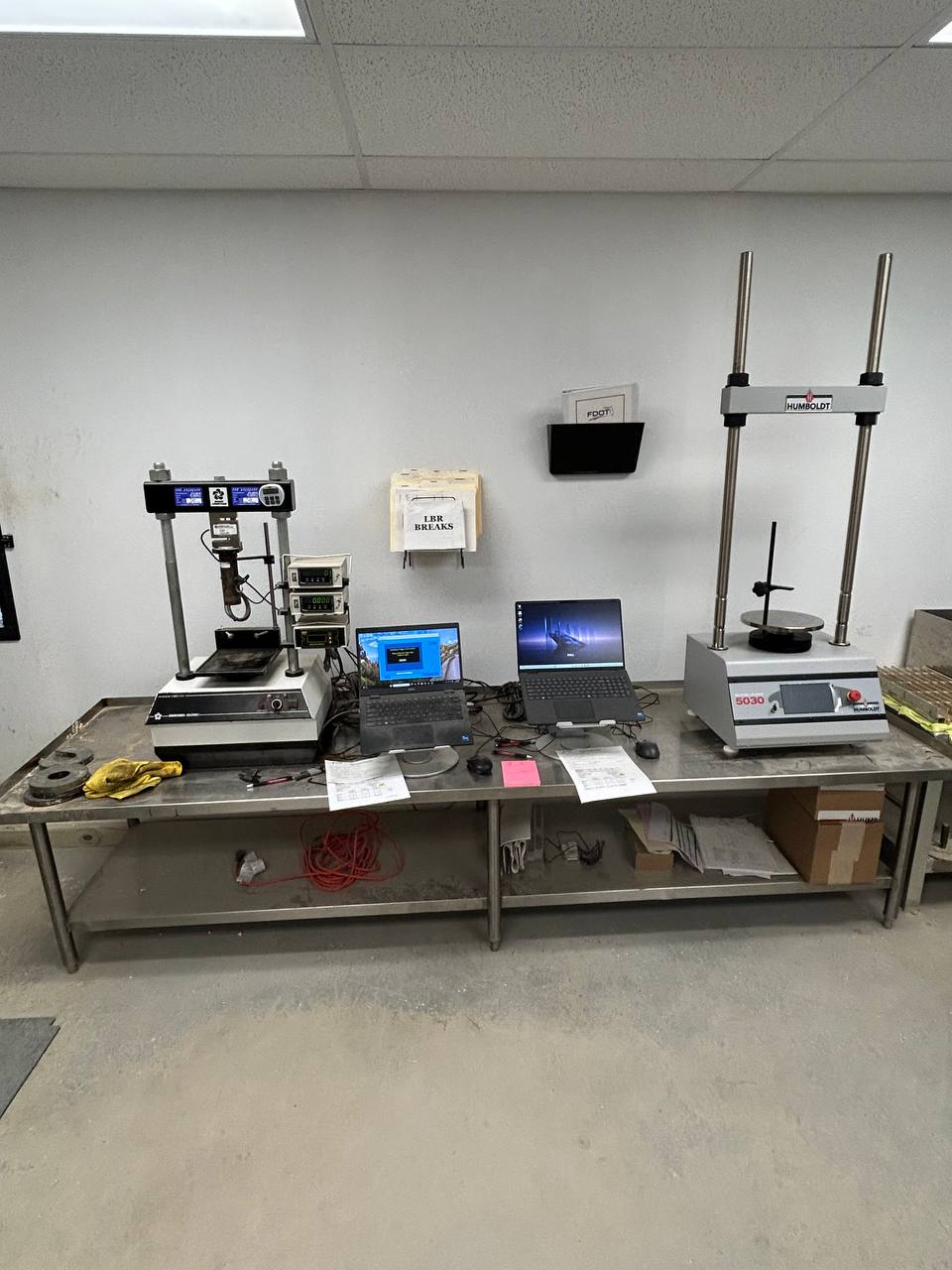
Proctor · LBR · Atterberg · Gradation
FDOT and CMEC accredited soil testing laboratory in Florida. Index tests, Proctor, Atterberg, LBR, consolidation, triaxial shear. 5–7 day turnaround. Call (352) 619-9292.
Every foundation recommendation, every compaction spec, every pavement section — it all traces back to lab data. The lab is where bad work shows up first. Or where it gets caught before it ever shows up at all.
FDOT and CMEC accreditation isn’t a sticker — it’s split-sample proficiency tests, calibration records traceable to NIST, and documented procedures for every test method we certify. Re-evaluated periodically. No coasting.
No shipping container, no third-party hands, no gap between field and bench. The sample that comes out of the spoon is the sample that gets tested. Most other firms can’t say that.
Index tests: 3–5 business days. Proctor: 5–7 days. Consolidation and triaxial shear: 2–4 weeks because they actually take that long, not because we put your samples in a queue.
A geotechnical report is only as reliable as the lab data underneath it. Every foundation recommendation comes from lab numbers. Every compaction spec is anchored to a Proctor curve. Every pavement section is sized using LBR or CBR. The engineering builds on the data, and if the data is wrong the engineering is wrong — even when it looks fine on paper.
Laboratory errors don’t show up at the lab. They show up months or years later — when a footing settles, when a pavement cracks early, when a slab won’t stop moving. By then nobody remembers that the Proctor was run on a sample that air-dried before testing. Or that the Atterberg was done on a dried-and-rewetted clay that underestimated the liquid limit by fifteen percent. Or that the unconfined compression specimen was disturbed when it was extruded from the tube. The lab is where these mistakes either get made or get caught, and the cost of catching them is always smaller than the cost of finding out later.
FGS operates an in-house soil and materials lab in Ocala. FDOT and CMEC accredited, with the proficiency testing, calibration records, and qualified personnel both programs require. We don’t subcontract testing. The sample your driller pulled out of the borehole at 32 feet is the sample that gets logged, prepared, tested, and reported — by us, on a bench we calibrated, on equipment we maintain.
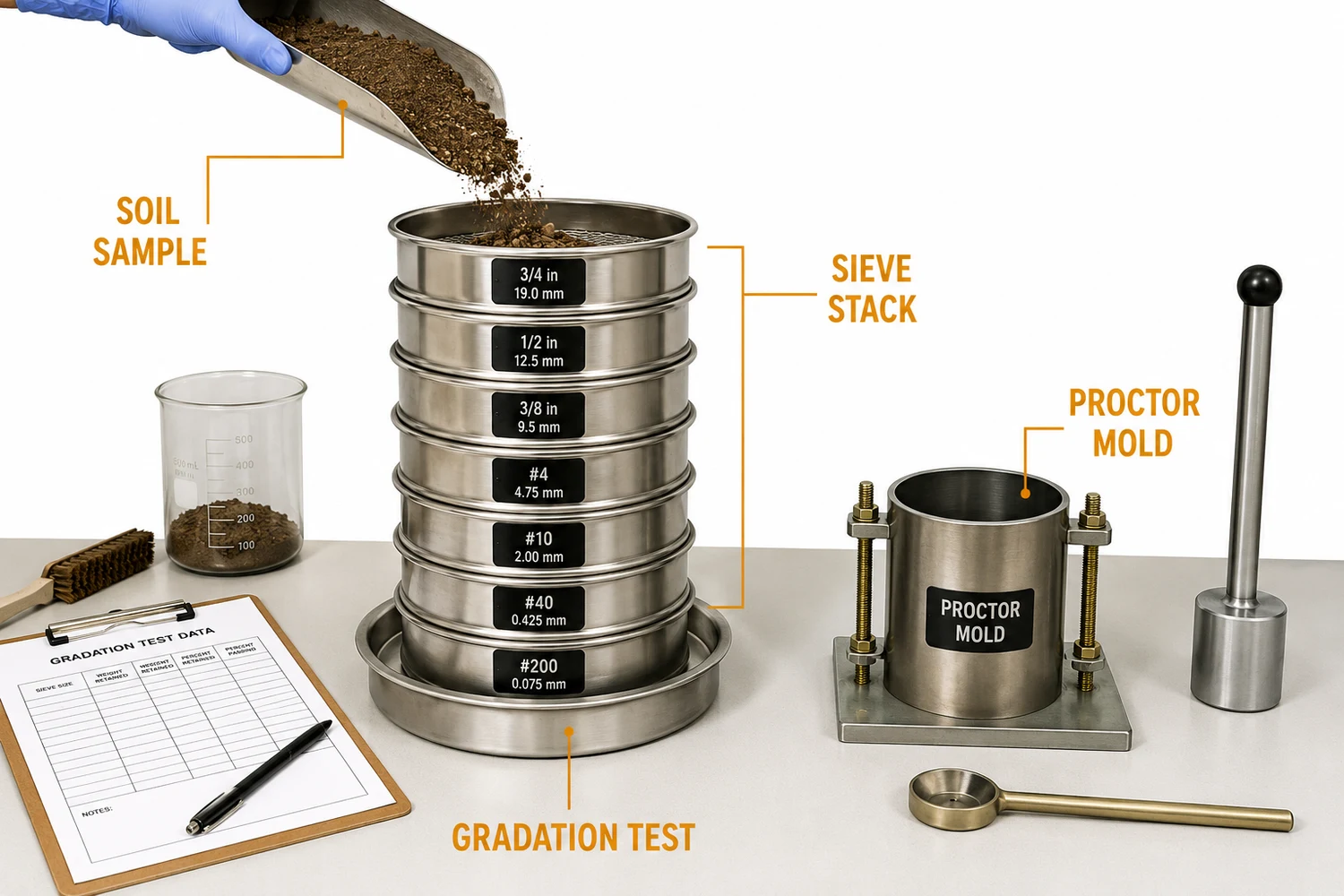
Laboratory testing is a discipline of small details that compound. Calibrated equipment, the right specimen preparation, the procedure run exactly as the standard specifies, careful sample handling from receipt through completion. Get any of those wrong and the result is wrong — but the result will still come back as a number, on a report, looking just like every other test result.
A few examples of what we mean:
A Proctor test on an air-dried sample produces a wrong maximum dry density. The field compaction spec built on that number is wrong. The fill that hits the spec is also wrong. The settlement six years later is the only one keeping a record.
Atterberg limits run on dried and rewetted clay can underestimate the liquid limit by 10–20% on highly plastic soils. Pavement engineers using that PI to choose subgrade treatment make the wrong choice.
Unconfined compression tests on disturbed cohesive samples significantly underestimate undrained shear strength. Foundation engineers using that strength to size footings over-conservatively, or worse, propose deep foundations when they weren’t necessary.
FDOT and CMEC accreditation force the discipline. Accredited labs participate in proficiency programs where the same sample gets tested by multiple labs and the results compared. Equipment calibration is tracked back to NIST standards. Personnel have to demonstrate proficiency for every test method they certify. None of that catches everything — but it catches a lot, and the labs that work that way produce data the engineers can trust.
Index tests describe what the soil is. Compaction tests describe what it can become. Strength and consolidation tests describe what it’ll do under load. We run all four pillars in-house.
Moisture content (ASTM D2216), grain size analysis (D6913 / hydrometer D7928), Atterberg limits (D4318), USCS and AASHTO classification, organic content (D2974), specific gravity (D854). The fundamentals — almost every geotech and CMT project starts here.
Standard Proctor (D698), Modified Proctor (D1557 / AASHTO T180), vibrating hammer compaction (D7382) for coarse-grained soils. LBR (FDOT FM 5-515) and CBR (D1883) for pavement design. The reference data every field density measurement is judged against. Pavement design →
Unconfined compression (D2166) for quick cohesive screening. Consolidated-undrained triaxial (D4767) for effective stress parameters (φ’, c’) used in long-term stability, bearing capacity, and pile design. Direct shear (D3080) for sandy soils and interface strengths.
One-dimensional oedometer consolidation (D2435) for settlement analysis on cohesive soils. Falling head (D5084) and constant head (D2434) permeability for septic, stormwater retention, dewatering, and contamination work.
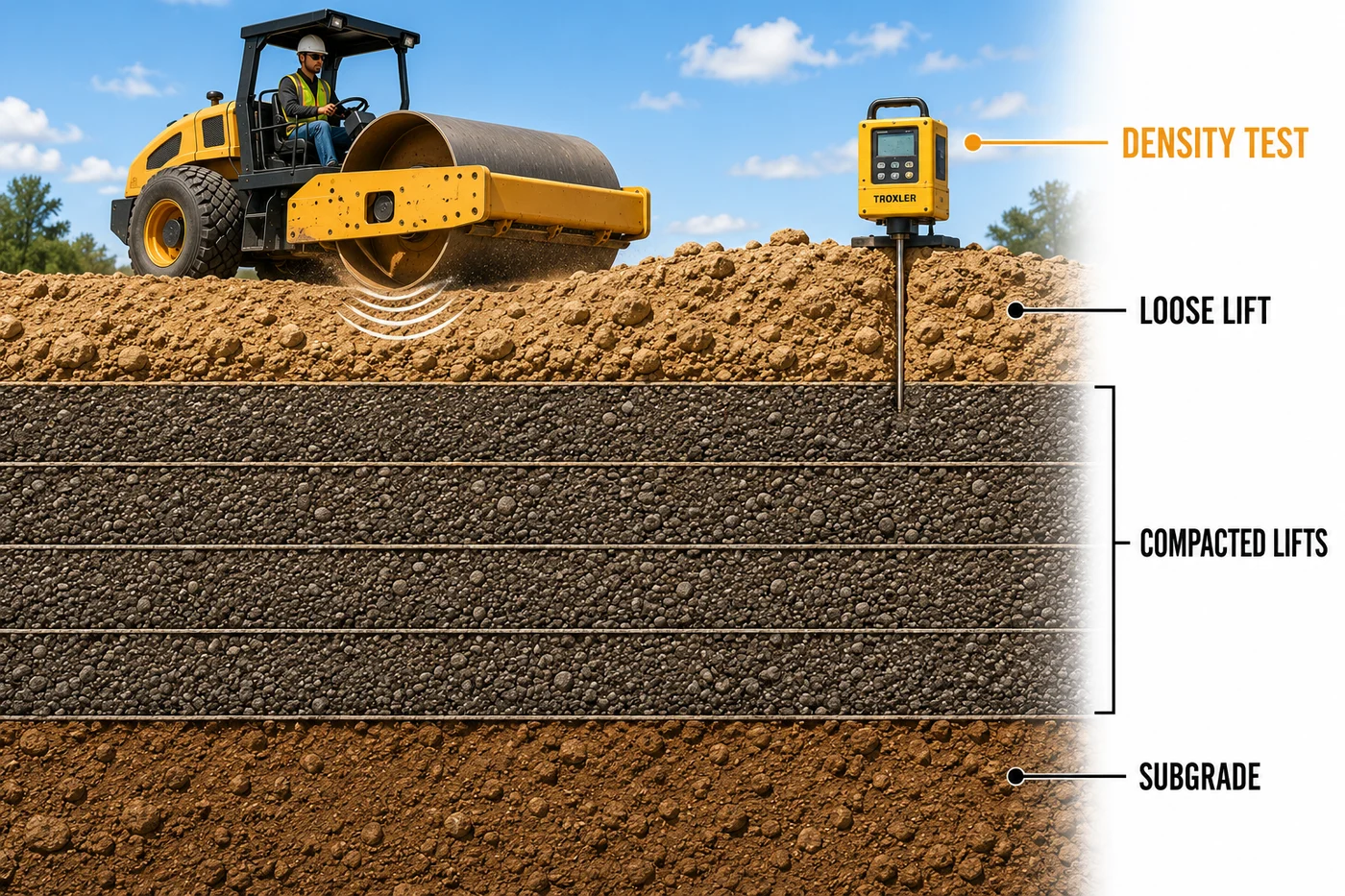
Take a routine job — a proposed warehouse in Ocala. Field crew advances SPT borings, recovers samples, sends them to the lab. We run:
From there, the engineer calculates an allowable bearing capacity of 2,500 psf for a spread footing at 2.5 feet below grade. Estimates elastic settlement of about 0.5 inches under design loads — within the 1.0-inch total / 0.75-inch differential tolerance for a warehouse slab. Specifies earthwork at 95% of Modified Proctor MDD within ±2% of optimum moisture for structural fill.
Every number in that paragraph traces back to a lab result. If the Proctor was wrong, the compaction spec is wrong. If the grain size or organic content was off, the bearing capacity calc shifts. If a Florida P.E. is putting their seal on that report, they’re staking their license on the assumption that the lab data was right. See foundation engineering →
Samples receive a chain-of-custody record at the rig and stay under that record through testing and reporting. Disturbed split-spoon samples go into sealed jars with boring number, sample interval, and date. Undisturbed tube samples for consolidation and triaxial work get handled with extra care — every disturbance to a Shelby tube sample shows up in the test results as artificially low strength or odd settlement behavior.
Typical turnaround:
Index tests (moisture, gradation, Atterberg, classification, organic): 3–5 business days
5–7 business days
2–4 weeks because they actually take that long
Reports follow the applicable ASTM or AASHTO methodology, with raw data, calculations, technician signatures, equipment IDs, and calibration dates. Because everything is in-house, we can release preliminary results as individual tests complete instead of waiting for the full package — useful when the engineer needs to start preliminary analysis before lab work finishes. Reports can be stamped by our P.E. where required.
Reliable foundations, compliant earthwork, and defensible reports all start with accurate lab data. FDOT & CMEC accredited. In-house chain of custody. Real turnaround times.
FAQ
FDOT accreditation is Florida-specific — it's what the Florida Department of Transportation requires for labs running tests on FDOT-let projects. They evaluate the lab's facility, equipment calibration, procedures, and personnel against FDOT-specific test method standards. CMEC (Construction Materials Engineering Council) is a national third-party accreditation body recognized by most state DOTs and federal agencies. Holding both means our results get accepted across the widest range of public and private work. We don't pick which one applies; the project does.
Index tests (moisture, gradation, Atterberg, classification, organic) — 3 to 5 business days from sample receipt. Proctor — 5 to 7 days. Consolidation and triaxial shear typically need 2 to 4 weeks because the specimen prep and the test itself take that long; nothing we do can compress a 24-hour consolidation increment into 6 hours. For urgent projects we can expedite within reason — call us and we'll be honest about what's possible.
Yes — submit-only work is fine, provided the samples are properly labeled (boring number, sample interval, collection date) and were transported and stored in a way that preserves their integrity. We can't certify the field collection if we didn't do it, but we can certify our testing on whatever you bring us. Call (352) 619-9292 to confirm current pricing and scheduling availability for submit-only work.
The Proctor compaction test (ASTM D698 or D1557) determines the relationship between moisture content and dry density for a given soil under a standard compaction effort. It produces a curve, and from that curve you get the maximum dry density and optimum moisture content. Every field density measurement on your project — every nuclear gauge reading, every sand cone test — is reported as a percentage of the Proctor MDD. Without a valid Proctor, the field readings have no reference. Get the Proctor wrong and the entire compaction QA/QC program is built on a wrong foundation. It is the reference standard.
We do laboratory permeability testing and field falling/constant head tests. Whether that satisfies formal Florida OSTDS septic permitting depends on the specific situation — Chapter 64E-6 of the Florida Administrative Code prescribes specific field percolation test methodologies under licensed supervision. Call us with your specific project and we'll tell you whether our work meets your permitting requirements or whether you need a different scope.
Get started
Tell us about your project and we'll get right back to you. Industry-leading turnaround on stamped reports, fieldwork, and lab results.
Prefer to talk? (352) 619-9292
Thanks — we've got it and we'll be in touch within one business day.
Need it now? Call (352) 619-9292.
Statewide service area
FGS delivers soil testing & lab across Central and North Florida from our Ocala lab. Explore the service in the communities we cover most: