Field density testing of structural fill and subgrade against the Proctor maximum, lift by lift
Home / Geotechnical Engineering The Villages FL
Geotechnical reports, sinkhole investigation, and materials testing in The Villages, FL. Stamped by a Florida-licensed P.E. Call (352) 619-9292.
SERVING THE VILLAGES — SUMTER, LAKE MARION COUNTIES — FROM OCALA
The Villages has been one of the fastest-growing communities in America for years, and all of that construction sits on covered karst: sand over Ocala Limestone, in one of the more sinkhole-active regions of the state. We provide geotechnical reports, sinkhole investigations, and construction materials testing across the tri-county area from our Ocala office, about 40 to 45 minutes away.
The Villages spans three counties — Sumter, Lake, and Marion — and it has repeatedly ranked among the fastest-growing metro areas in the United States. That growth is concrete-intensive: residential slabs by the thousands, commercial pads, recreation facilities, roadway networks, utility corridors, and stormwater ponds, all moving on schedules that do not leave room for a geotechnical report sitting in a queue.
Every one of those structures bears on the same general subsurface profile, and it is a profile that deserves respect. The construction volume here is enormous; the geology underneath it is classic Central Florida karst.
The short version: sand over limestone, with not much in between. Across most of the tri-county area, surficial sands and clayey sands sit directly on Ocala Limestone, with the clay-rich Hawthorn Group thin, breached, or absent. Where the Hawthorn confining layer is missing, slightly acidic groundwater moves freely down into the limestone, and dissolution creates voids, conduits, and weakened zones in the rock and the soil above it.
In covered karst, the failure mode is usually not the limestone collapsing. It is the sand cover raveling downward into openings in the rock. Done slowly, that produces cover-subsidence sinkholes — broad, gradual depressions that show up as settlement cracks and out-of-level floors. Done suddenly, it produces cover-collapse sinkholes, the kind that make the news. The surrounding region has a long documented history of both.
This shows up plainly in boring data. SPT N-values that drop abruptly above the rock surface, weight-of-rod or weight-of-hammer intervals, and lost drilling fluid circulation are the signatures of raveling soil and open voids. A boring program designed for this geology goes deep enough to penetrate the questionable zone and tag competent limestone — not just deep enough to satisfy a generic minimum. Ground penetrating radar is a useful screening layer across larger sites because it covers area between borings, though GPR has limits in clayey or wet soils and we say so when it applies.
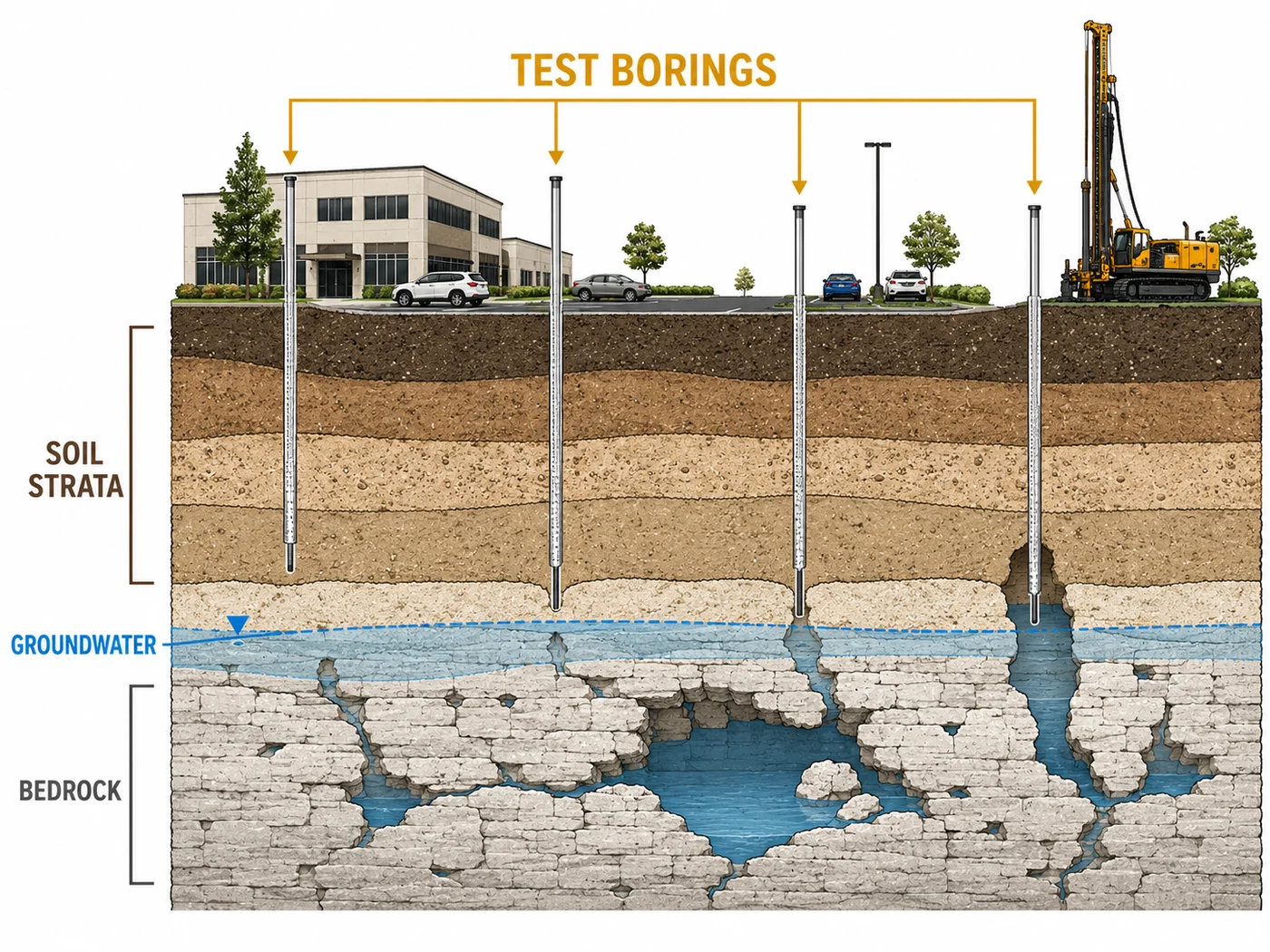
If you are putting up pads, roads, or community infrastructure in or around The Villages, our work falls into two phases: before design and during construction.
Before design, we run the subsurface exploration and produce a geotechnical report signed and sealed by a Florida-licensed P.E. — allowable bearing capacity, settlement estimates, groundwater levels, and foundation recommendations matched to what the borings actually found. For roadway and parking work, that extends to pavement design built on lab-measured LBR values rather than assumed ones. For stormwater ponds, it means honest seasonal high groundwater estimates, because an infiltration pond designed against the wrong water table does not infiltrate.
During construction, our field and lab staff handle construction materials testing:
Field density testing of structural fill and subgrade against the Proctor maximum, lift by lift
cylinders, slump and air, asphalt cores and densities
Special inspections where Chapter 17 of the Florida Building Code requires them
Proctor, LBR, and classification testing in our in-house accredited laboratory, which keeps turnaround inside your pour schedule instead of outside it
High-volume residential construction lives and dies on testing turnaround. A density test that takes three days to come back is a stopped crew. Because our lab is in-house and the drive from Ocala is 40 to 45 minutes, we can support production schedules that out-of-area firms struggle with.
Most of the homeowner calls we get from The Villages start with cracks: stair-step cracking in block, slab cracks, doors that stopped closing. The honest answer is that most settlement cracking is not a sinkhole. Slabs crack from concrete shrinkage, from fill consolidating, and from normal differential settlement. But in covered karst, “probably not a sinkhole” is not the same as “not a sinkhole,” and the only way to close the question is subsurface data.
A sinkhole investigation here typically combines GPR screening around the structure with SPT borings advanced into the limestone, looking for the raveled zones and voids described above. If you are pursuing an insurance claim, Florida Statute 627.707 sets out how sinkhole loss claims are handled; our role is the geotechnical side — determining what is actually under the house and putting it in a stamped engineering report.
The other common homeowner need is smaller-scale geotechnical work: borings and a short report for a room addition, a lanai enclosure, or a garage expansion, where building departments in the area commonly ask for documentation of bearing conditions before permitting the added load. These are modest scopes — usually one or two borings — and we price them that way.
We are based in Ocala at 302 SW 33rd Ave, 40 to 45 minutes from The Villages depending on which end of it you are on. The sequence is the same for a production builder or a single homeowner: scope call, proposal, utility locates, drilling, lab testing, stamped report. Standard residential investigations typically deliver in one to two weeks after fieldwork; larger commercial scopes typically run two to three weeks. If a backlog or a scope change moves that, you hear it from us before it happens, not after.
And the standing caveat, because it is true everywhere in karst country: borings characterize the points where they are drilled, GPR sees what its physics allow it to see, and no investigation proves a void cannot exist somewhere between data points. What we provide is a defensible picture of the subsurface, the warning signs flagged, and recommendations a structural engineer or an insurer can act on — with the limits of the data stated in the report, not buried.
FAQ
Yes, in the sense that matters: the tri-county area sits on covered karst — sand over Ocala Limestone with the confining Hawthorn clays thin or absent — and this part of Central Florida has a documented history of both cover-subsidence and cover-collapse sinkholes. That does not mean every lot is at meaningful risk; karst features are local and irregular. It means the risk is real enough that subsurface data, not assumption, should answer the question for any specific site.
Not necessarily. Most cracking is shrinkage or ordinary differential settlement, and a full sinkhole investigation is not cheap, so we do not push one as the default first step. Patterns that raise the level of concern include stair-step cracks that keep widening, floors going progressively out of level toward one area, depressions forming in the yard, and doors or windows racking in one section of the house. If you describe what you are seeing when you call (352) 619-9292, we will give you a straight read on whether an investigation is justified or whether you are likely looking at routine settlement.
Residential scopes — additions, settlement evaluations, single-lot reports — typically run $1,500 to $3,500. Commercial pads and larger developments typically run $5,000 to $20,000+ depending on footprint, loads, and boring depths; in karst terrain the borings need to reach competent limestone, and depth drives drilling cost. Full sinkhole investigations with GPR plus deep borings are scoped case by case. Every report is stamped by a Florida-licensed P.E.
That is most of why builders in the tri-county area use us. The lab is in-house and accredited, the office is 40 to 45 minutes away, and density results, Proctors, and concrete breaks come back on the schedule the pour calendar needs. We will also tell you when we are at capacity rather than take work we cannot turn around — a late density report costs you more than an honest scheduling conversation does.
Get started
Tell us about your project and we'll get right back to you. Industry-leading turnaround on stamped reports, fieldwork, and lab results.
Prefer to talk? (352) 619-9292
Thanks — we've got it and we'll be in touch within one business day.
Need it now? Call (352) 619-9292.
Serving The Villages
Every FGS service line is available throughout The Villages — fieldwork, drilling, and our in-house accredited lab, all from Ocala: