New or widening stair-step cracks in block or stucco walls
Home / Sinkhole Inspection in Citrus County, FL
Sinkhole investigations & geotechnical engineering in Inverness, Lecanto, Crystal River & Homosassa. GPR screening, SPT borings. Call (352) 619-9292.
INVERNESS · LECANTO · CRYSTAL RIVER · HOMOSASSA
Citrus County sits on some of the most sinkhole-active ground in the United States: thin sandy soils directly over weathered Ocala Limestone, in the karst belt that runs from Tampa Bay up through Ocala. We investigate suspected sinkholes with GPR screening and SPT confirmation borings, and a Florida-licensed P.E. stamps what we find — including when the answer is "this isn't a sinkhole."
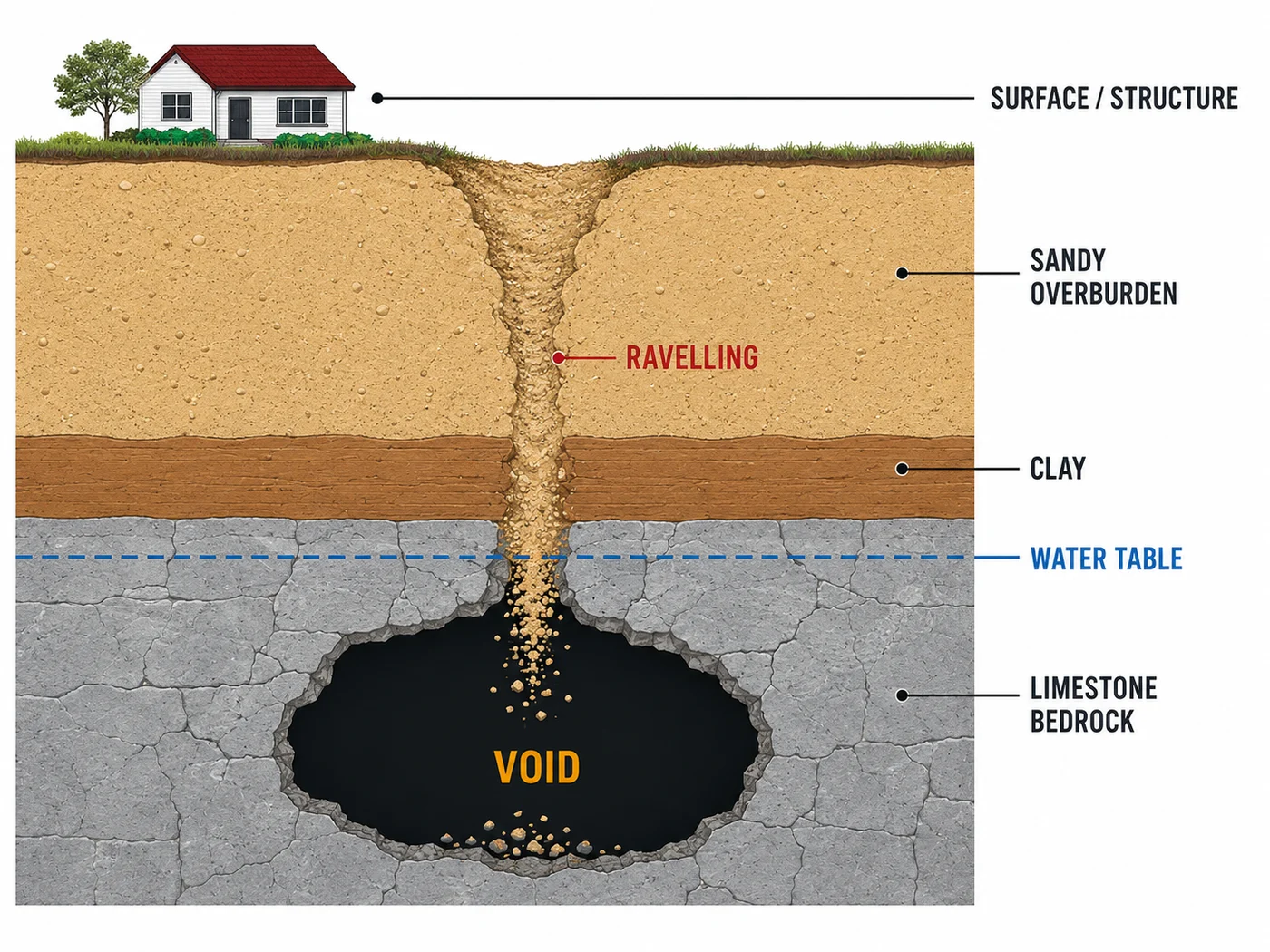
The springs are the giveaway. Kings Bay at Crystal River and the Homosassa springs exist because the Ocala Limestone here is shallow, cavernous, and full of moving groundwater. The same dissolution that built the springs builds voids under house pads. Across much of the county — Inverness, Lecanto, the Brooksville Ridge through the eastern half — the limestone sits under only a thin cover of sand, and near the coast the water table is high enough that soils stay saturated most of the year.
Sand over cavity, plus water movement, is the sinkhole recipe. Fines wash downward into openings in the rock — raveling — until the loose zone reaches the surface as a slow depression or, rarely, a sudden collapse. Citrus County and its neighbors to the south make up the region geologists and insurers treat as Florida’s most sinkhole-active. That doesn’t mean every property here has a problem. It means the question deserves real data instead of a drive-by opinion.
New or widening stair-step cracks in block or stucco walls
Doors and windows that have racked out of square recently, not gradually over decades
Circular or elongated depressions forming in the yard, driveway, or under the slab
Slab cracks paired with a measurable change in floor slope
Cracks that reopen after repair
None of these confirm a sinkhole. Buried organics, old construction debris, plumbing leaks, and ordinary shrink-swell movement in clayey soils produce the same symptoms. That is the entire point of an investigation: separating karst activity from everything else that makes a building move. We close out plenty of investigations with a finding of no sinkhole activity, and that conclusion is worth as much as the opposite one — it’s the difference between a foundation repair scope and a ground stabilization scope.
We start with ground-penetrating radar run in survey grids across the structure and the surrounding ground. GPR images contrasts in the shallow subsurface and flags anomalies — disturbed zones, depressions in soil layering — that tell us where to look harder.
Then we confirm with SPT borings, because an anomaly is a place to drill, not a diagnosis. In the borings we’re reading the classic karst signatures: N-values dropping toward zero above the limestone, weight-of-rod or weight-of-hammer zones where the sampler sinks under its own weight, sudden loss of drilling fluid circulation into voids, and raveled soil structure in the recovered samples. Samples go to our in-house accredited laboratory for classification, and depth to limestone gets logged at every hole.
The deliverable is a signed and sealed report from a Florida-licensed P.E. stating what was found, what it means, and what we couldn’t determine — written to hold up under the scrutiny an insurance claim or a real estate dispute will put on it. The methodology is described in more detail on our sinkhole investigation page.
GPR is a screening tool, and we use it as one. Its depth of penetration drops sharply in conductive, clayey soils and below the water table — a real constraint near the Citrus coast, where groundwater is shallow. It can’t see beneath a strong reflector, and it images contrasts, not causes: a GPR anomaly might be a raveling chimney, or it might be a buried stump. Anyone who hands you a sinkhole verdict from GPR alone is selling past the limits of the method. That’s why the standard of practice pairs geophysics with confirmation borings, and why we do it that way without exception.
Florida Statute 627.707 lays out how sinkhole insurance claims are handled, including the professional standards an investigation has to meet. Two things Citrus County homeowners should know going in: most Florida policies cover catastrophic ground cover collapse by default, while broader sinkhole loss coverage is typically an optional endorsement — check your policy before assuming either way. And the insurer’s investigation is the insurer’s; if you want an independent technical read on the findings, that’s a legitimate reason to bring in your own engineer.
Buyers in Citrus County increasingly want a karst screening before closing — sometimes because of visible distress, sometimes because of a prior repaired claim in the property’s history, sometimes just because of the zip code. We scale the scope to the question, from GPR screening to full investigation with borings. For commercial acquisitions, a Phase I environmental site assessment often runs alongside the geotechnical work, and bundling the site visits saves money.
For new builds, the karst question gets answered before the foundation design is finalized, not after. Near the coast — Crystal River, Homosassa, Ozello — the high water table adds its own constraints: seasonal high groundwater estimates drive stemwall versus monolithic slab decisions, fill requirements, and whether dewatering belongs in the earthwork bid. The Suncoast Parkway’s arrival on the county’s west side is pulling commercial development with it, and those projects need the same standard geotechnical reports, borings, and construction-phase testing as anywhere else in the state. The full service list is on our geotechnical engineering services page.
We work out of Ocala at 302 SW 33rd Ave — Inverness, Lecanto, and Crystal River are 40 to 60 minutes from the office and our lab. Call (352) 619-9292.
FAQ
Usually, no. In our experience most investigated depressions trace back to something other than karst: buried organics or land-clearing debris decomposing and settling, an old septic or well feature, a leaking pipe washing out fines, or poorly compacted fill from original construction. All of these settle, and from the surface they can look identical to early sinkhole activity. The distinction matters because the fixes are completely different — and so are the disclosure and insurance implications. A subsurface investigation with borings is how you get an answer you can act on rather than a guess. We’d rather tell you it’s a rotted stump than let you assume it is.
In broad strokes: you report the damage, the insurer inspects, and if the damage is consistent with sinkhole activity and you carry the coverage, the statute provides for testing by qualified professionals to confirm or rule out a sinkhole as the cause. The statute also provides a neutral evaluation process when the homeowner and insurer disagree about the findings or the repair approach. Where we fit: performing investigations that meet the professional standards the statute references, and giving homeowners an independent technical review of an insurer’s report when the conclusions don’t sit right. We’re engineers, not adjusters or attorneys — we won’t advise you on claim strategy, but we will tell you whether the subsurface data supports the conclusions drawn from it.
For context, residential geotechnical reports generally run $1,500 to $3,500 and commercial reports $5,000 to $20,000+. A full sinkhole investigation — GPR survey plus multiple deep SPT borings plus laboratory work plus an engineering report written for claim scrutiny — is a custom scope, and the boring depths required to reach and penetrate the limestone are the biggest cost driver. We quote it after a short conversation about the property and the question being asked, because a pre-purchase screening and an insurance-grade investigation are not the same product. Timeline runs from rig scheduling through drilling, lab testing, and report writing — typically a few weeks end to end, faster when the scope is screening-level. Being 40 to 60 minutes away helps; we’re not building cross-state mobilization into either the price or the schedule.
No. GPR identifies anomalies; it does not identify causes. A disturbed zone in a radar profile could be raveling soils over a void, or it could be a buried stump, an old utility trench, or backfilled debris. Penetration is also limited in wet, clayey, or conductive ground — common conditions in coastal Citrus County — so a clean GPR survey is not the same thing as a clean site. Confirmation comes from SPT borings: blow counts, drilling behavior, fluid loss, and recovered samples, read together by an engineer. GPR earns its place by telling us where to drill. It doesn’t replace the drilling, and we’ll say that to anyone who asks.
Get started
Tell us about your project and we'll get right back to you. Industry-leading turnaround on stamped reports, fieldwork, and lab results.
Prefer to talk? (352) 619-9292
Thanks — we've got it and we'll be in touch within one business day.
Need it now? Call (352) 619-9292.
Serving Citrus County
Every FGS service line is available throughout Citrus County — fieldwork, drilling, and our in-house accredited lab, all from Ocala: