FDOT-Method Design
Flexible pavement sections designed to FDOT standards — Section 334 Superpave mixes, limerock or stabilized subgrade, properly calibrated traffic loading. The same methodology that built Florida’s interstate system.

Flexible & Rigid Design · FWD Testing
Florida pavement design and rehabilitation engineering — FDOT-method flexible design, LBR subgrade evaluation, overlay design. Call (352) 619-9292.
FDOT Methods · Flexible Pavement · LBR Subgrade Evaluation
Pavement doesn’t fail from traffic. It fails from water and subgrade. We design pavement sections that survive Florida’s high water tables and assess failing pavement by figuring out what’s actually under it — not just what’s cracked on top.
Flexible pavement sections designed to FDOT standards — Section 334 Superpave mixes, limerock or stabilized subgrade, properly calibrated traffic loading. The same methodology that built Florida’s interstate system.
Most pavement failures we’re called for aren’t pavement problems — they’re subgrade and drainage problems. We diagnose what’s actually wrong before recommending a fix you’ll be redoing in three years.
Overlay design, mill-and-fill, full-depth reclamation, base replacement — sized to existing condition, projected traffic, and realistic service life. Not just “add two inches and hope.”
Florida pavement faces a different list of enemies than pavement in Minnesota or Arizona. Up north it’s freeze-thaw. Out west it’s solar UV and aging asphalt. In Florida it’s water — a high water table, hurricane-season saturation, and the steady erosion of base-course fines that follows every heavy rain.
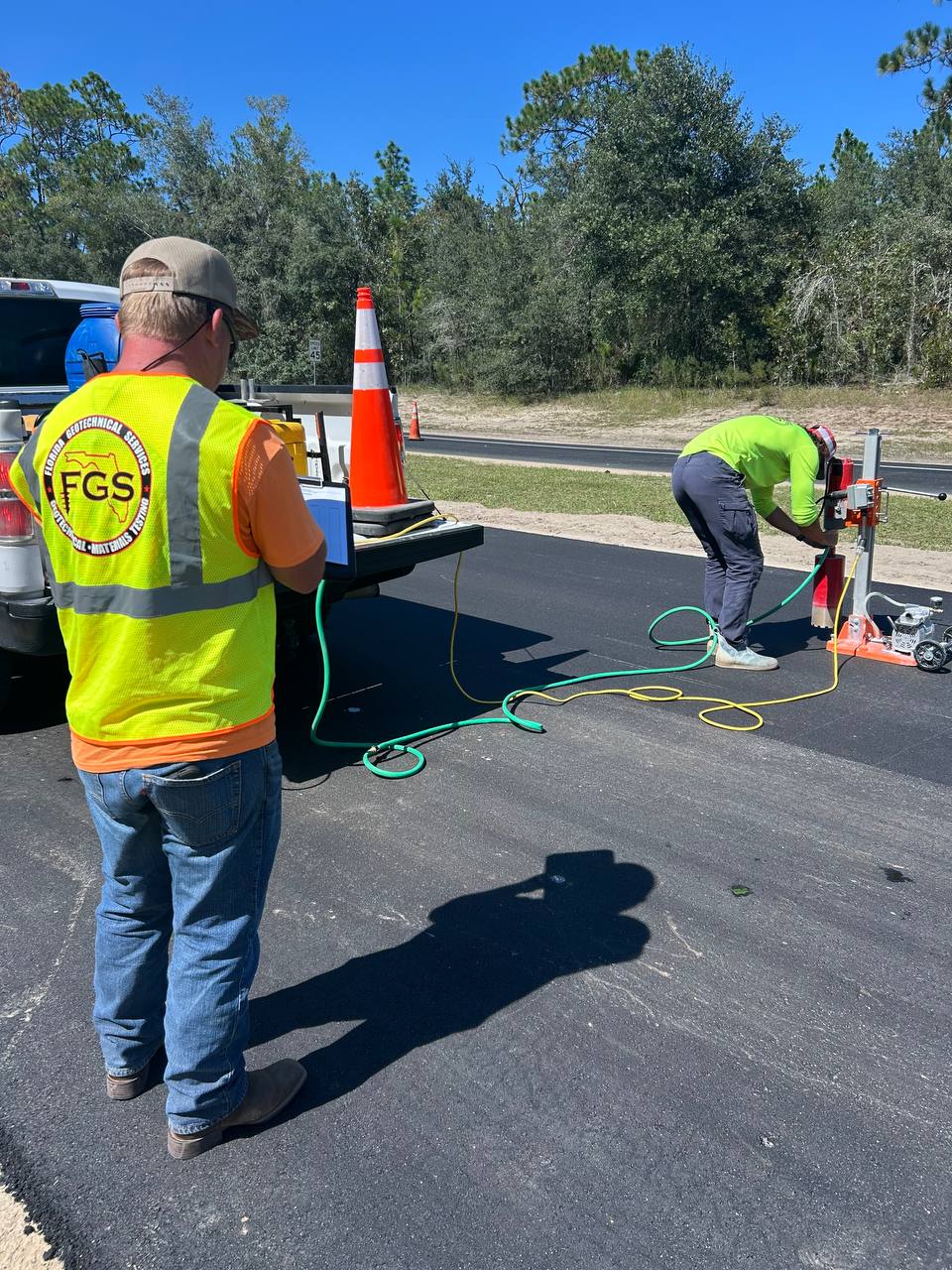
FDOT has spent decades figuring out what works in Florida soils. Limerock base over a stabilized subgrade, Superpave HMA above, properly crowned and drained — that recipe holds up. The pavements that don’t hold up are the ones that skip a step: thin asphalt over inadequate base, no real subgrade preparation, drainage that wasn’t designed at all. Most of the failed pavement we core into tells the same story.
FGS designs new pavement sections for parking lots, private roads, commercial sites, and public projects across Florida. We also evaluate existing pavement — figuring out why it’s failing, what it’ll take to fix, and how long a given rehabilitation strategy will actually last. The design work happens under Dave’s seal, with FDOT methodology behind it.
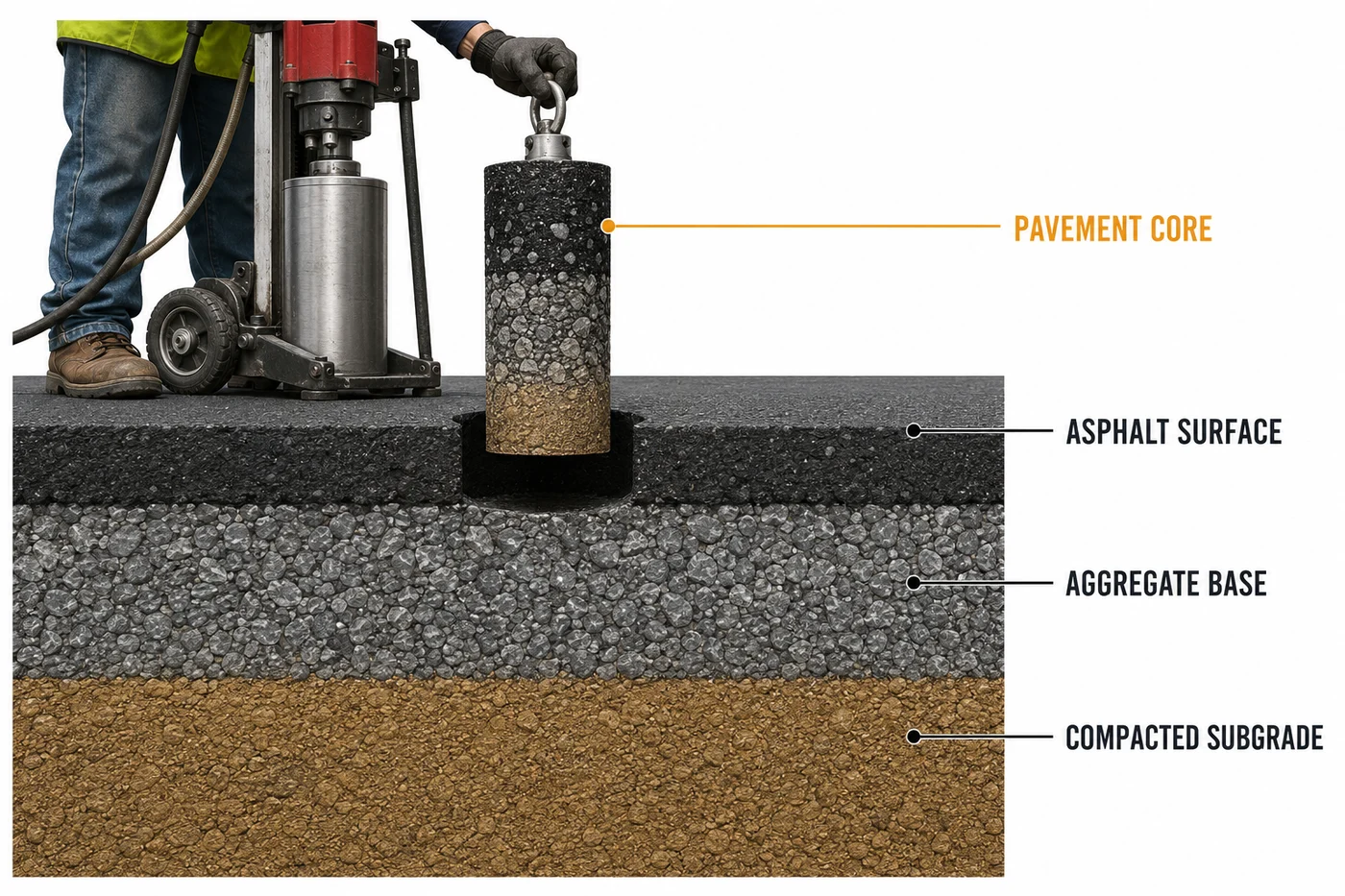
A flexible pavement section is a stack — asphalt on top, base course in the middle, subgrade underneath. The strength of the section comes from the whole stack working together. Take away support from underneath, and the layer above can’t carry traffic no matter how thick or expensive it is.
In Florida, the subgrade is almost always sand — fine, clean, with low fines content. That sounds bad for pavement support, but properly compacted Florida sand carries traffic well when it’s confined and kept reasonably dry. Where it loses strength is when the water table rises into the base or when fines from the base migrate down into saturated subgrade. The drainage design is what keeps the section dry enough to perform — and most of what we see fail is failed drainage, not failed asphalt.
Limerock base is the Florida workhorse — a cemented carbonate that interlocks under compaction and gives the section meaningful structural value. FDOT specifications dictate gradation, plasticity, and LBR strength. Where limerock isn’t economical, soil-cement and crushed concrete base substitutes are written into FDOT spec. The point is: the base course is where the structural number comes from, and underdesigning it to save money on day one is the most expensive choice you can make over a 20-year service life.
From greenfield design through forensic evaluation of failing pavement, the work is one continuous discipline. Each scope below is something we deliver as a stamped engineering product — not just field data and a invoice.
Greenfield design for parking lots, private roads, commercial drives, and public projects. Traffic estimation, subgrade evaluation (LBR/CBR), structural number calculation per FDOT/AASHTO methods, layer thickness recommendations, drainage requirements. Designed-for-Florida sections, not Northern textbook defaults.
Systematic distress surveys per ASTM D6433 — cracking, rutting, raveling, potholes — converted to a Pavement Condition Index (PCI). Walk-the-site surveys for parking lots and small networks; windshield surveys for larger networks. The output is a prioritized maintenance and rehabilitation roadmap.
Pavement cores to measure actual layer thicknesses, hand-auger or SPT boring through the section to log base and subgrade, GPR runs for continuous layer profiles. The forensic data that tells you what you actually have to work with.
Sized for existing condition and projected traffic — overlays, mill-and-fill, full-depth reclamation (FDR), partial-depth or full-depth base replacement. Drainage corrections engineered alongside the surface work. Service-life projections that take saturation into account.
Water reaches the pavement section from three directions and each one wears the pavement out differently:
surface infiltration. Cracks in the wearing course let surface water through into the base. Once water is in the base, traffic pumping under wheel loads erodes the fines and progressively destroys structural support. The pumping is what you hear when a tire rolls over a saturated pothole edge.
capillary rise and water-table fluctuation. Florida’s water table is often within four to six feet of the surface, sometimes within two. After heavy rain or hurricane saturation, it can rise into the base course itself. The subgrade loses strength; the section deflects more under traffic; cracking accelerates.
lateral seepage off adjacent grades. Sites where adjacent landscaping or detention ponds drain toward the pavement, sites with broken stormwater piping under the parking lot, sites with positive drainage that was lost over years of resurfacing — all of these put water into the section laterally and silently.
A pavement design that doesn’t address all three water paths is a design that’s going to fail early. An overlay on a pavement that’s failing from water — without fixing the water — is money set on fire.
Pavement design isn’t picking a thickness from a table. It’s a calculation that takes four inputs seriously:
Traffic loading. Equivalent Single Axle Loads (ESALs) over the design life — not just car counts, but the distribution of trucks, buses, and delivery vehicles that do the actual damage. A parking lot designed for a single delivery box truck per day is a different design than a parking lot the same size at a distribution warehouse.
LBR or CBR. The Limerock Bearing Ratio (FDOT) or California Bearing Ratio (broader) of the natural subgrade after compaction, with seasonal moisture variation considered. Florida sand LBRs typically run 20–40; weak organic or fat-clay subgrades can drop below 10 and require stabilization or undercut-and-replace.
Material structural numbers. Layer coefficients for the asphalt, base, and stabilized subgrade per AASHTO/FDOT methodology. Different mixes, different bases, different stabilization methods all contribute different structural value per inch.
Design life and reliability. A 20-year pavement is designed differently than a 10-year pavement. A high-reliability design (low probability of premature failure) is thicker than a median design. Both are valid engineering choices — the conversation should happen at the design stage, not after the section is built.
FGS runs the calculation using FDOT’s design procedures and the AASHTO 1993 framework that FDOT methods are derived from. For larger municipal and DOT projects, AASHTOWare Pavement ME is used where required. The deliverable is a designed section, sealed and signed, with the assumptions documented so the contractor and owner can both see what was designed for.
Tell us the project — new pavement design, condition assessment, overlay scoping, or a failing section that needs a diagnosis — and we’ll scope the work and turn around a fast quote. Industry-leading lead times; pavement designs typically inside two weeks.
FAQ
Maybe — and maybe not. Before recommending a repave, we core the pavement to see what the actual section looks like, log the base condition, and check whether the failure mode is surface-only (oxidation, raveling, age cracking) or structural (alligator cracking, rutting, pumping). Surface failures get an overlay or mill-and-fill at a fraction of the cost. Structural failures need the base addressed. The diagnosis dictates the cost — and the diagnosis costs a tiny fraction of guessing wrong.
That's the wrong question. The right question is what total section — asphalt, base, and stabilized subgrade — your traffic and subgrade conditions require. For a typical commercial parking lot in Florida, designs commonly land somewhere around 1.5–2 inches of asphalt over 6–8 inches of limerock base over a stabilized subgrade. For a truck-loaded site, those numbers go up across the board. We don't quote thicknesses without a designed section behind them — quoting thickness from a phone call is how parking lots end up failing in three years instead of twenty.
LBR — Limerock Bearing Ratio — is the FDOT-standard subgrade strength index. It comes from a laboratory penetration test on a compacted, soaked sample and expresses subgrade load-carrying capacity as a percentage of standard limerock. Higher LBR means stronger subgrade and a thinner section can carry the same traffic. Lower LBR means weaker subgrade and either a thicker section or some form of stabilization (lime, cement, geogrid, undercut-and-replace) is needed. The LBR drives the design — getting it wrong by ignoring lab testing is the single most common reason pavement gets undersized.
For a single small lot — usually not. A walk-through assessment with photographs and a recommendation memo is sufficient. PCI surveys earn their cost on multi-lot portfolios, HOA road networks, business parks, and municipal pavement networks where prioritization across multiple segments drives the rehab budget. If you've got more than a few segments to rank and budget, the formal PCI work pays for itself.
Yes — and we do it often. Pavement designs are frequently a late-stage civil drawing that needs to be signed and sealed before construction. We work from the civil's grading plan, traffic estimates, and any available geotech, run the calculation, and produce a stamped pavement section detail to drop into the construction documents. Turnaround is usually under two weeks once we have the inputs in hand.
Get started
Tell us about your project and we'll get right back to you. Industry-leading turnaround on stamped reports, fieldwork, and lab results.
Prefer to talk? (352) 619-9292
Thanks — we've got it and we'll be in touch within one business day.
Need it now? Call (352) 619-9292.
Statewide service area
FGS delivers pavement design & evaluation across Central and North Florida from our Ocala lab. Explore the service in the communities we cover most: