Designed From the Data Up
Bearing capacity from real SPT and lab numbers, not rules of thumb. Settlement analysis from real Proctor and consolidation data. Our recommendations come from our own field and lab work — same engineer, same chain.

Bearing Capacity · Piles · Settlement Analysis
Florida foundation engineering for residential, commercial, and FDOT projects. Shallow and deep foundation design, karst-aware. Call (352) 619-9292.
Foundation failure is almost never a structural problem. It’s a geotechnical one. Shallow or deep, spread or driven, residential or FDOT bridge — every recommendation we put a seal on starts with what the dirt actually is, not what the drawings hope it is.
Bearing capacity from real SPT and lab numbers, not rules of thumb. Settlement analysis from real Proctor and consolidation data. Our recommendations come from our own field and lab work — same engineer, same chain.
Karst limestone, loose fine sands, shallow water tables, hurricane uplift, organic muck pockets at 30 feet. Florida foundation engineering looks nothing like the textbook examples from anywhere else.
We don’t disappear after the report. We talk to your structural engineer about the design loads, the foundation alternatives, and the construction observation. Recommendations that actually get built right.
When a foundation cracks, the structural drawings usually get blamed first. Almost always, the structural drawings are fine. The problem is the soil — under-characterized, over-assumed, or just unlucky. Reinforced concrete and steel can be engineered to remarkable precision. The dirt they sit on is variable, anisotropic, and often surprising. Foundation engineering is the discipline of designing the structural fix to that variability.
In Florida, that variability is unusually severe. The same parcel can have dense sand from grade to 12 feet, organic muck from 12 to 18, and pinnacled limestone from 18 down — with the rock surface itself varying by 25 feet across the building footprint. A shallow spread footing in the wrong spot drops into the muck and settles for years. A driven pile in the right spot hits rock at 22 feet and carries the load like it’s supposed to. The difference is whether somebody knew which spot was which before pouring concrete.
FGS provides foundation engineering across the full range of Florida projects — residential additions, custom homes, commercial buildings, FDOT bridges, transmission towers, the works. Florida P.E. #58334. FDOT Work Group 9.4.1 (Standard Foundation Studies). Every recommendation comes from FGS’s own field investigation and lab data, because we don’t trust other firms’ chain-of-custody as much as we trust our own.
Most of peninsular Florida’s near-surface soil is fine silica sand. It looks the same everywhere — clean, light tan, drains well — but the SPT N-values can range from 3 to 30 across the same parcel. Loose sand under a multi-story building means settlement problems unless somebody designs around it. Net allowable bearing pressures of 1,500 to 3,000 psf are common on Florida sands, which is fine for residential and light commercial but tight for anything heavier.
Central Florida sits over Ocala Limestone and the Floridan Aquifer System. Dissolution voids, raveling overburden, and pinnacled rock surfaces show up across Marion, Hernando, Pasco, Citrus, Hillsborough, and most counties along the I-4 corridor. A shallow foundation in karst terrain without a proper subsurface investigation is a gamble. Sometimes the right answer is a deep foundation that bypasses the questionable overburden and bears on competent rock. Sinkhole investigation →
Water within 2 to 4 feet of grade is normal in coastal lowlands. Seasonally within 6 to 10 feet across most of the interior. That changes the math: saturated fine sands lose bearing capacity, buoyancy forces matter on below-grade elements, driven pile capacities can be reduced near surface. Foundation design that ignores the water table designs for a Florida that doesn’t exist.
Florida’s wind exposure under ASCE 7 and the FBC produces net uplift forces on foundation elements that often govern the design — particularly for coastal and high-wind zones. Helical piers and driven piles get analyzed for tension capacity, not just compression. Spread footings get sized for overturning resistance. Foundation engineering that treats Florida like Ohio gets surprised when the wind blows.
Peat and muck layers from former wetlands and floodplains show up at all depths across coastal Florida. They look like nothing special on a quick visual log but consolidate dramatically under load — and they can keep consolidating for years. A foundation that bears partially on muck and partially on sand differentially settles, and the building tells you about it later.
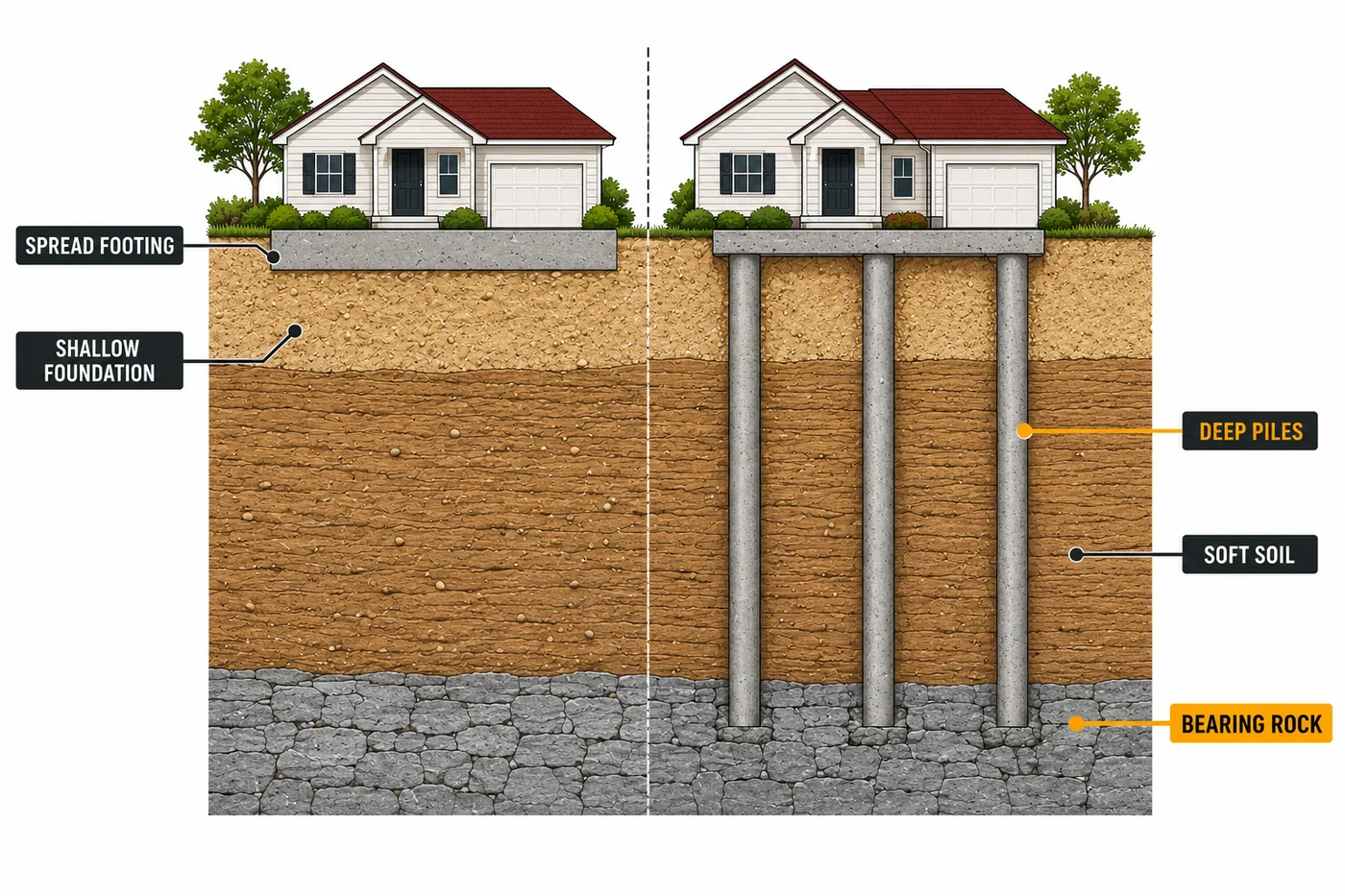
There is no universally “best” foundation. Best is whatever fits the loads, the soil profile, the site constraints, and the project economics. Four broad families cover almost everything we design.
Spread footings, continuous wall footings, mat slabs. The right answer when near-surface soils are competent enough to carry the load within tolerable settlement. Net allowable bearing pressures on Florida sands typically 1,500–3,000 psf for medium-dense conditions. Cheap to build, fast to install, but they need the site to cooperate.
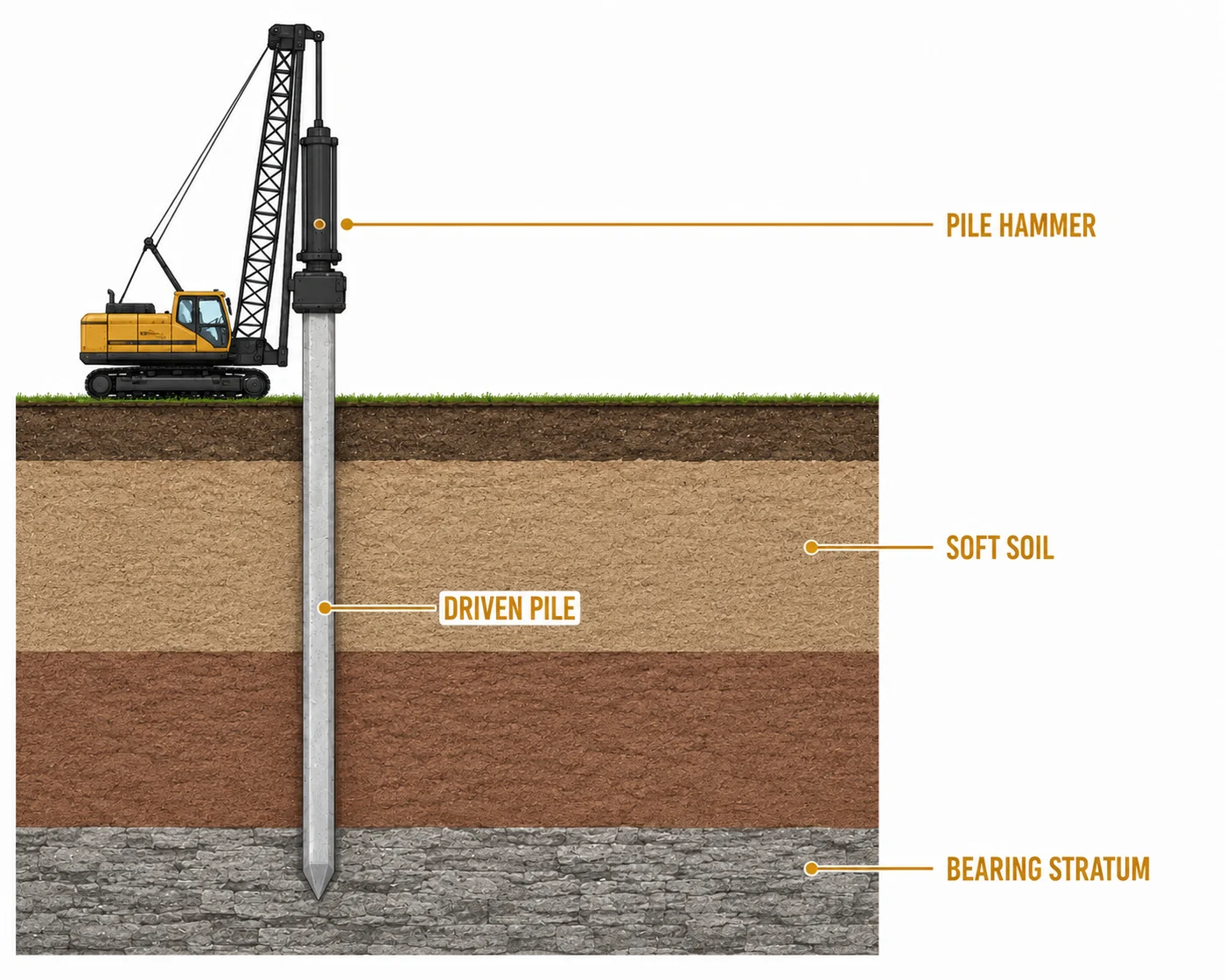
Precast concrete, steel H-piles, pipe piles driven by impact hammer. End bearing plus skin friction, capacity verified by wave equation analysis (WEAP) and dynamic load testing (ASTM D4945). Bread-and-butter for FDOT infrastructure and most commercial work where loads are concentrated.
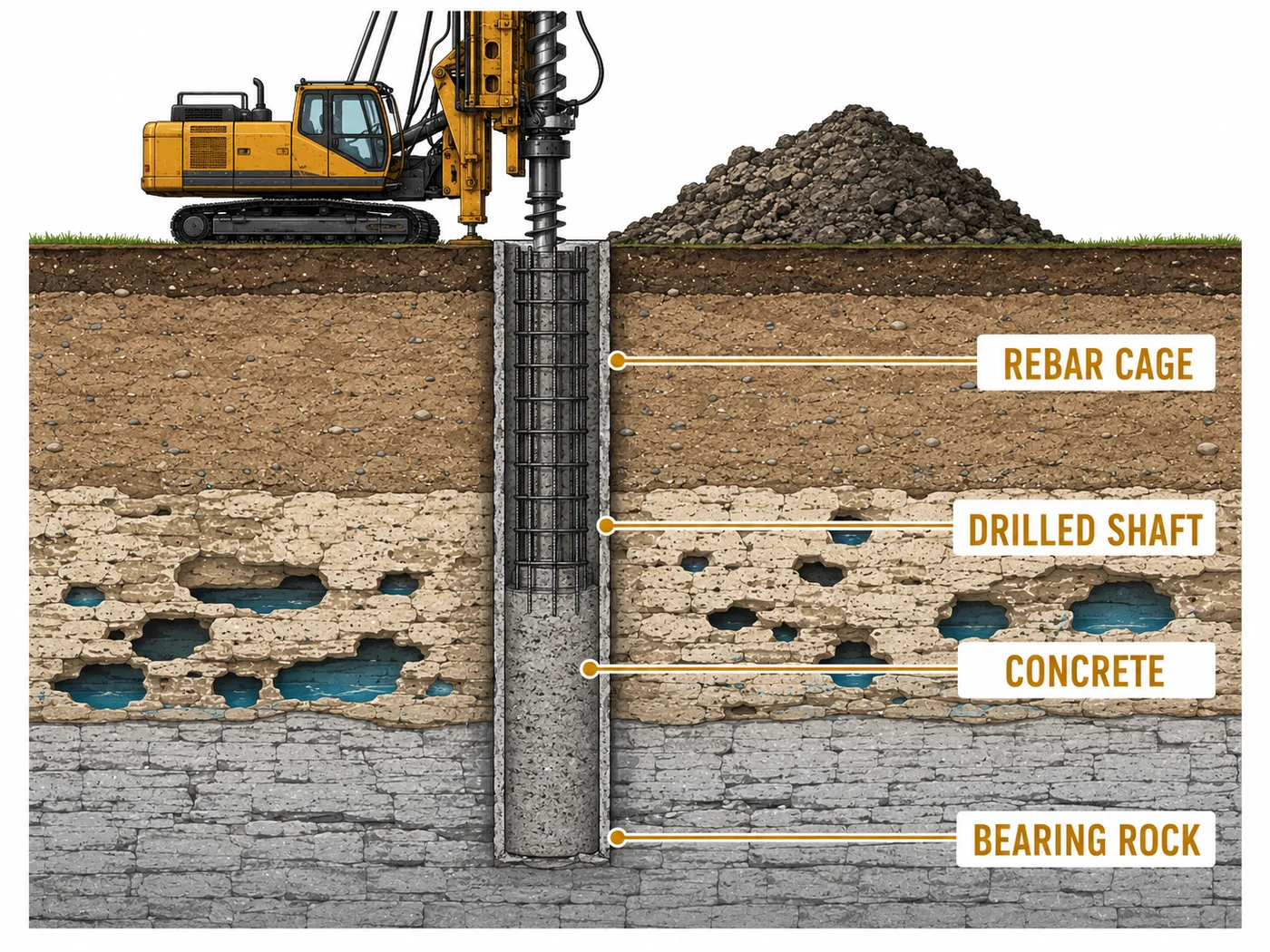
Continuous-flight auger advances, grout pumped through the hollow stem as the auger withdraws, cage reinforcement placed. No vibration, no noise, no soil displacement — important near sensitive structures or in urban work. Capacity from SPT correlations, verified by CSL or PIT integrity testing and load tests.
Large-diameter drilled shafts for bridge piers and high-rise buildings — designed using the Florida Limestone Design Manual for rock socket capacity in karst. Helical piers for residential, light commercial, and underpinning — fast install, torque-to-capacity verification (ICC AC358), no spoil.
Foundation engineering isn’t really four steps so much as four conversations:
1Site InvestigationSPT borings per ASTM D1586 to depths driven by structure loads, sometimes CPT for continuous profiles, rock coring where competent rock is the bearing layer. Our crews, our rigs, our lab — chain of custody from field through engineering. Drilling capabilities →
2Subsurface Profile InterpretationField data and lab results synthesize into a subsurface model — a cross-section showing layer depths, engineering properties, the zones of concern. Loose sand needing ground improvement. Compressible organics. Depth to rock. Seasonal groundwater. For karst sites, GPR data supplements borings to catch what individual borings might miss. GPR methodology →
3Foundation Analysis & RecommendationBearing capacity calculations (Meyerhof, Hansen, Vesic). Settlement analysis — elastic for sands, Terzaghi consolidation for cohesive. Pile capacity from SPT correlations or load testing. Lateral load analysis with p-y curves for drilled shafts. The report includes allowable bearing pressure, footing embedment, settlement estimates, pile type and minimum tip elevation, capacities, and any ground improvement or sinkhole remediation requirements.
4Coordination & Construction ObservationWe talk to your structural engineer of record so the recommendations make it into the foundation drawings correctly. During construction, we observe foundation work and provide materials testing to verify the actual conditions match the design assumptions. The report isn’t the end of the conversation — it’s the start of it. CMT services →
Homebuilders and homeowners often underestimate the geotechnical complexity of Florida residential construction. Many sinkhole-prone counties — Marion, Hillsborough, Pasco, Hernando — now require site-specific investigation for any new dwelling. Even where not required, a pre-construction geotech runs a fraction of what a foundation remediation costs after the fact. FGS does residential SPT borings, lab testing, foundation recommendations for new homes, additions, accessory structures, pool foundations, and forensic evaluations for existing homes showing distress.
Commercial and infrastructure foundation engineering scales the rigor up — more borings, deeper investigation, formal AASHTO LRFD analysis for bridges, ASCE 7 wind for tall structures. FGS covers multi-story buildings, FDOT bridge foundations, retaining walls and MSE walls, tank and silo foundations (with liquefaction susceptibility assessment), transmission and communication tower foundations. Work complies with FDOT Structures Design Guidelines, AASHTO LRFD Bridge Specifications, ASCE 7, and the Florida Building Code as applicable.
FAQ
For most projects above a small accessory structure, yes — the Florida Building Code requires it. Many sinkhole-prone counties require it for any new construction regardless of size. Even where not legally required, any site with unknown soils, history of filling, proximity to wetlands or sinkholes, or planned loads above typical residential should get an investigation before foundation design. The investigation is a fraction of what a failed or remediated foundation costs. Always.
The data decides. Shallow foundations (spread footings, mats) work when near-surface soils are competent enough to carry the load within tolerable settlement. Deep foundations (piles, drilled shafts, helical piers) are used when near-surface soils aren't competent, when sinkhole risk argues for bypassing the overburden, or when uplift and lateral loads need a system that handles them efficiently. The SPT N-values, the depth to competent bearing, the load magnitude, and the consequence of differential settlement all feed into the recommendation. Sometimes the answer is a hybrid — shallow with ground improvement, or shallow on prepared subgrade with deep where loads concentrate.
It varies by soil and density. Dense sands and stiff residual soils over limestone can support 2,000–4,000 psf. Loose fine sands can be limited to 750–1,500 psf. Compressible organic soils (muck, peat) have near-zero allowable bearing pressure — you have to bridge them or remove them. These ranges are starting points, not design numbers. Site-specific investigation and lab data produce the actual recommendation a structural engineer can put on drawings.
Where investigation reveals karst features — raveling, dissolution voids, anomalous SPT refusal — shallow foundations often aren't acceptable without ground improvement first. Compaction grouting can stabilize overburden enough to allow shallow construction. Deep foundations that bear on or socket into competent limestone bypass the questionable overburden entirely. Sometimes the right answer is a combination. The decision is part engineering, part economics, and part owner risk tolerance — but it always starts with a sinkhole-aware subsurface investigation, not assumptions.
Yes. Forensic geotechnical evaluation is a meaningful piece of our work. We investigate the soil under the structure, look at the distress pattern, distinguish sinkhole activity from normal settlement from expansive soil from a construction defect, and recommend remediation — underpinning, helical pier installation, compaction grouting, drainage improvement, or some combination. The honest assessment of cause matters because the cheapest fix isn't the right fix if it doesn't address what's actually happening.
Get started
Tell us about your project and we'll get right back to you. Industry-leading turnaround on stamped reports, fieldwork, and lab results.
Prefer to talk? (352) 619-9292
Thanks — we've got it and we'll be in touch within one business day.
Need it now? Call (352) 619-9292.
Statewide service area
FGS delivers foundation engineering across Central and North Florida from our Ocala lab. Explore the service in the communities we cover most: