Home / Geotechnical Engineering in Lake County, FL
Geotechnical engineering in Lake County, FL — borings, compaction testing, sinkhole investigation for Clermont, Leesburg, Mount Dora. Call (352) 619-9292.
CLERMONT · LEESBURG · MOUNT DORA · TAVARES · EUSTIS · MINNEOLA
Most of Florida is flat. Lake County isn't. Between the sand hills of the Lake Wales Ridge and the shorelines of the Harris Chain, this county puts more topography into a site investigation than almost anywhere else in the state — and topography changes the questions a geotechnical engineer has to answer.
Drive south on US 27 from Leesburg toward Clermont and you climb. The hills around Clermont and Minneola sit on the northern reach of the Lake Wales Ridge, a relict dune system of deep, clean, fine sands — the “sugar sand” anyone who has tried to compact it dry already knows. Sugarloaf Mountain, at 312 feet one of the highest points in peninsular Florida, is a short drive from downtown Clermont.
Ridge sands are, in several respects, good foundation soils. They drain fast, the water table sits well below the crests, and there is little of the shrink-swell clay that complicates construction in other states. The catch is density. These fine sands are frequently loose in their natural state — standard penetration test N-values in the upper ten feet often come back low — and loose sand settles when you load it. On flat ground that is a manageable problem. On a hillside it interacts with grading, and grading is where most Lake County foundation problems begin.
A sloped lot in Clermont, Minneola, or Montverde almost always gets graded: cut on the uphill side, fill on the downhill side. If a foundation straddles the cut/fill line, half the structure bears on undisturbed native sand and half bears on whatever was pushed over the edge. When that fill wasn’t placed in controlled lifts, moisture-conditioned, and density-tested against a laboratory Proctor, the two halves settle differently. Differential settlement on cut/fill lots is one of the most common distress patterns we investigate.
The fix is procedural, not exotic. Fill goes down in thin lifts, each lift gets a field density test, and the test is meaningless without a Proctor curve from a real lab behind it. We run compaction and density testing in the field and the supporting Proctors, gradations, and moisture work through our own accredited soil testing laboratory in Ocala, so results don’t wait on a third party. Building departments in the area commonly ask for density test reports on structural fill, and Chapter 17 of the Florida Building Code puts soils work under special inspection on threshold and many commercial projects.
Buying a finished lot in an established subdivision? Grading there may be decades old with no surviving records. A few borings will tell you whether you’re on native ground or undocumented fill before you pour on it.
The Harris Chain — Harris, Griffin, Eustis, Dora — plus several hundred smaller lakes give Lake County its name and a recurring geotechnical condition: organic soils near the shoreline. Muck and peat accumulate where water has stood for thousands of years. They are dark, soft, compressible, and still decomposing, which means they lose volume over time even without load. A seawall, dock, pool, or lakeside addition founded on or above organics will move.
The first job on a lakefront site is defining the organic layer — how thick, how deep, how far it runs back from the water. That takes borings, not guesswork; muck thickness can change by several feet over one lot width. Once it’s mapped, the options are straightforward: excavate and replace if the layer is thin, or carry loads through it on deep foundations if it isn’t. Our foundation engineering recommendations come stamped by a Florida-licensed P.E., with the boring logs and lab data that justify them.
South Lake County is building toward Orlando along US 27, SR 50, and the Turnpike, and the work has shifted from custom homes to subdivisions, townhomes, retail pads, and warehouses. That scale changes the geotechnical workload: mass-grading earthwork QA, seasonal high groundwater estimates for stormwater ponds, subgrade evaluation for new roads and parking, and special inspections under FBC Chapter 17. The ridge sands handle this kind of development well — but only with compaction control from the first lift to the last, because a loose zone under a warehouse slab announces itself after the racking goes in, not before.
Older downtowns run the other direction. Infill projects in Mount Dora, Eustis, and Tavares sit on previously developed ground — old foundations, abandoned utilities, undocumented fill from earlier structures. Borings on infill lots regularly find things the survey doesn’t show.
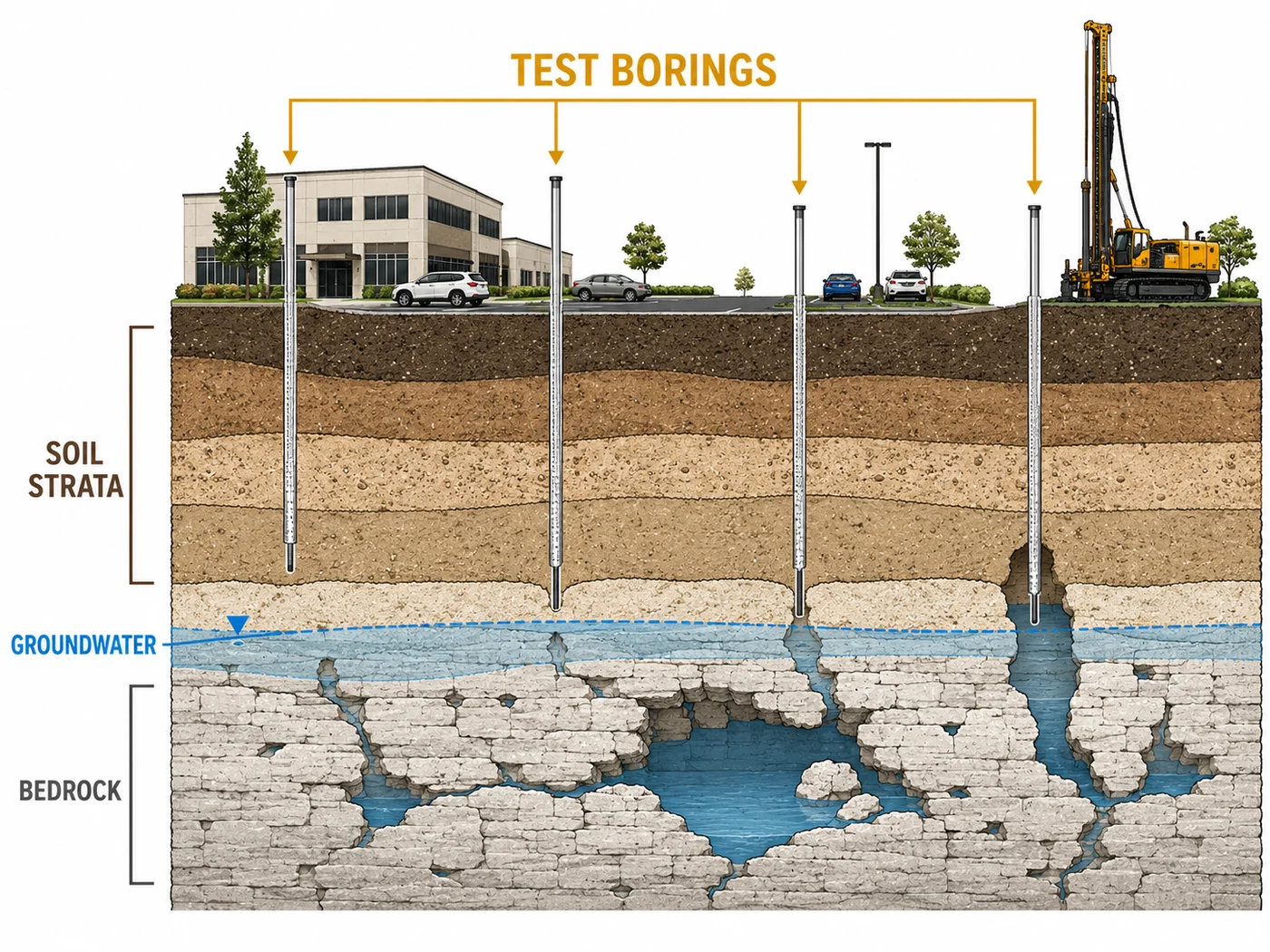
Lake County doesn’t carry the sinkhole reputation that Citrus or Hernando does, but the same limestone is down there, and the cover-collapse mechanism doesn’t respect county lines. Subsidence incidents are documented across the county. If you’re seeing stair-step cracking in block walls, doors that have stopped closing, or a depression opening in the yard, the responsible move is a sinkhole investigation — typically SPT borings to refusal paired with geophysics — rather than a patch job. For insurance purposes, Florida Statute 627.707 sets out the framework for sinkhole loss claims, and the testing it contemplates is exactly this kind of subsurface work.
We’re based in Ocala at 302 SW 33rd Ave — about 50 minutes from Leesburg or Tavares and roughly an hour from Clermont. That’s close enough to mobilize a rig without the standby and travel charges that come with crews dispatched from Orlando or Tampa.
A typical project runs: a scoping call to size the boring program to the structure, drilling and sampling on site, laboratory testing in-house, and a stamped geotechnical engineering report with foundation recommendations your structural engineer and building department can use directly. FGS was founded in 2023, the lab is accredited and ours, and we work all 67 Florida counties. Call (352) 619-9292 to talk through a Lake County site.
FAQ
Residential investigations generally run $1,500–$3,500 depending on lot access, slope, and the number and depth of borings. Commercial work typically falls between $5,000 and $20,000+, driven by building footprint and the loads involved. Sloped lots on the ridge sometimes need an extra boring or two to map the cut/fill line — that’s a few hundred dollars of drilling that can prevent a six-figure underpinning problem later.
“Compacted” without density test reports is a claim, not a record. If lift-by-lift density tests tied to a laboratory Proctor exist, ask for them — that’s the documentation building departments in the area commonly want anyway. If they don’t exist, a short boring program through the pad will show whether the fill is dense enough to build on. Clean ridge sand can look firm at the surface and still be loose three feet down.
Less so than Citrus, Hernando, or Pasco, but the answer is not “no.” Limestone underlies the county, sinkholes are documented here, and the deep sands can mask developing voids until surface symptoms appear. We don’t recommend sinkhole testing for every property — for most sites it isn’t warranted. Where there’s visible distress, an insurance question under Statute 627.707, or a lender requirement, a proper investigation gives you an engineering answer instead of speculation.
For a typical single-family residence we usually carry SPT borings 15–25 feet below planned foundation grade, deeper where fill is thick or loads are concentrated. On sloped lots the depth is measured from finished grade, not existing grade — if six feet of fill is planned on the downhill side, the borings have to account for it. Heavier commercial structures and any site with suspected organics or karst indicators get deeper programs, scoped per site rather than off a template.
Get started
Tell us about your project and we'll get right back to you. Industry-leading turnaround on stamped reports, fieldwork, and lab results.
Prefer to talk? (352) 619-9292
Thanks — we've got it and we'll be in touch within one business day.
Need it now? Call (352) 619-9292.
Serving Lake County
Every FGS service line is available throughout Lake County — fieldwork, drilling, and our in-house accredited lab, all from Ocala: