Home  /  Geotechnical Engineering in Sumter County, FL

Geotechnical Engineering in Sumter County, FL

Geotechnical engineering, soil borings, and CMT for Wildwood, Bushnell & The Villages. Ocala-based firm with in-house lab. Call (352) 619-9292.

  • FDOT Accredited Lab
  • CMEC Accredited
  • In-House Laboratory
  • All 67 FL Counties
Geotechnical Engineering in Sumter County, FL

WILDWOOD · BUSHNELL · THE VILLAGES · THE I-75 CORRIDOR

Sumter County is permitting big-footprint warehouse slabs and miles of new pavement at a pace the area has never seen, and most of it is going up over covered karst. We're a geotechnical engineering firm based in Ocala — 35 to 45 minutes up I-75 from Wildwood — with an in-house accredited soils lab, and every report we issue is stamped by a Florida-licensed P.E.

The Wildwood interchange changed the county’s geotechnical workload

Wildwood sits where I-75 meets Florida’s Turnpike, and the land around that junction is filling in with distribution centers, truck terminals, fuel sites, and the retail that follows them. At the same time, The Villages continues to build south through Sumter County. Ten years ago the typical local geotechnical job was a house pad or a small commercial outparcel. Now it’s a tilt-up warehouse with a slab measured in acres.

That changes the engineering. A 200,000-square-foot slab is far less forgiving than a residence. An inch of differential settlement a house would shrug off can rack high-bay storage, open slab joints under forklift traffic, and put a tilt-up panel out of tolerance. Pavement that carries loaded trucks all day fails by different mechanisms than a street that carries golf carts. The boring program, the lab scope, and the construction testing all have to be sized to the structure — not copied from the last job.

What’s actually under Sumter County: covered karst

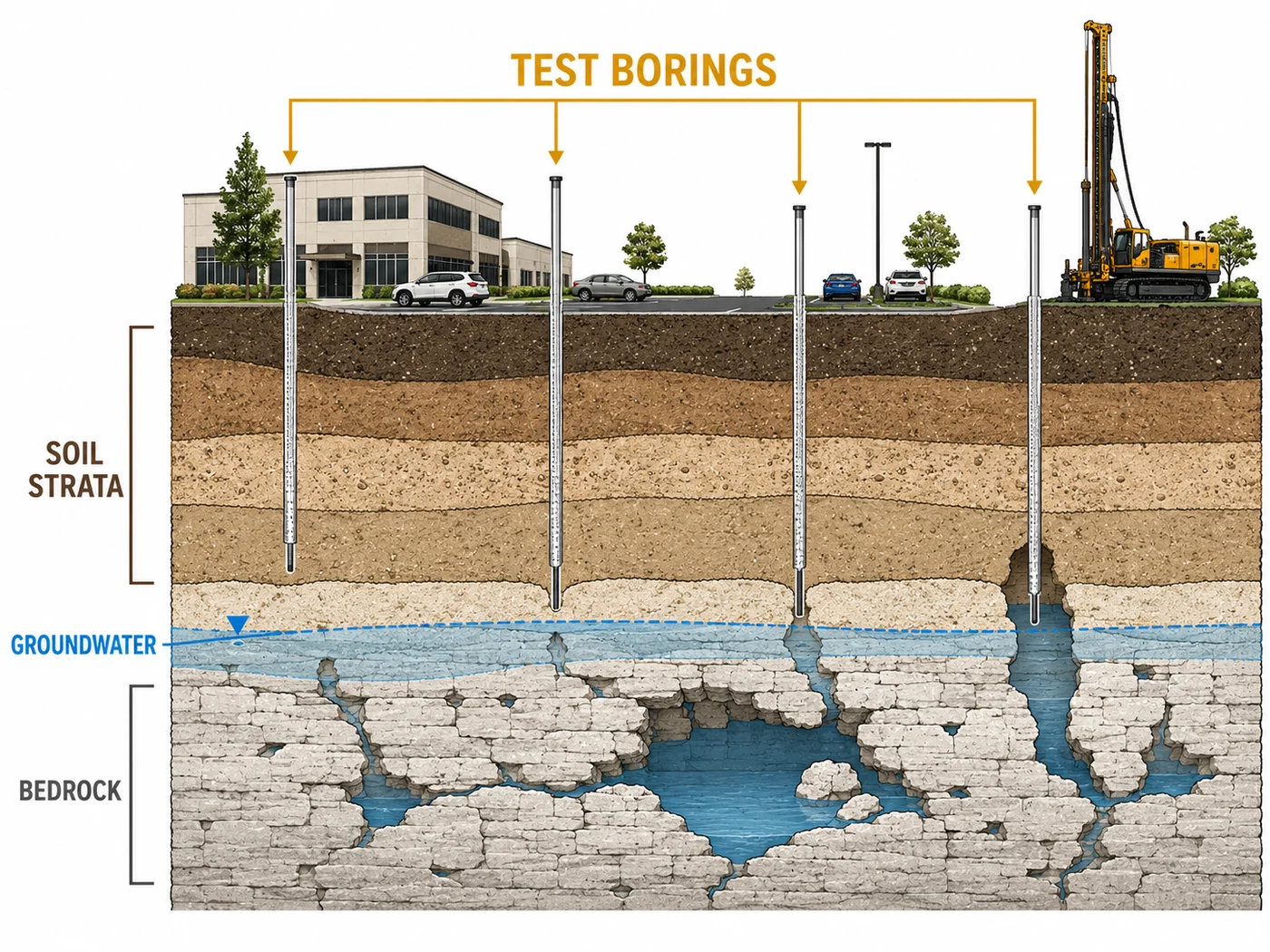
Most of Sumter County is covered karst. A blanket of sand and clayey sand sits on the Ocala Limestone, which lies close to the surface across much of the county and carries the dissolution features limestone develops everywhere in this part of Florida. Water moving down through the surficial aquifer carries fines into openings in the rock — a process called raveling — and over time a raveled zone can propagate upward as a loose, low-blow-count layer or, less often, as a surface collapse.

Most sites here are fine. But “most” is not a design basis. SPT borings tell you what the N-values are doing at depth: whether the profile firms up onto competent limerock, or whether there’s a soft raveled zone above the rock that the foundation design has to account for. On land deals where karst is the question itself, a focused sinkhole and karst investigation before closing is cheap relative to finding the problem during mass grading.

One honest caveat that belongs on every geotechnical page: a boring samples a few inches of soil at intervals, at a handful of locations on a site that may cover forty acres. We lay out borings where the loads will be — column lines, tank pads, pond berms — and the report states plainly what we observed and what the boring spacing can’t rule out.

Services by project type

Warehouse, industrial, and distribution

Heavy column loads and large slabs start with a deep SPT boring program scaled to the structure. From the borings and lab work we develop bearing capacity and settlement estimates, subgrade preparation and compaction criteria, and ground improvement options where the upper profile won’t perform as-is. During construction, our construction materials testing crews handle field densities on structural fill, concrete sampling on large pours, and the Florida Building Code Chapter 17 special inspections that commercial projects carry. Big continuous pours are where CMT scheduling actually matters — a rig and a technician that are 40 minutes away behave differently than ones mobilizing from Tampa or Orlando.

Residential development

For subdivisions and the build-out south of the SR 44 corridor, the work runs from due-diligence borings before land purchase, through mass grading compaction control, to per-lot density testing and foundation recommendations. In covered karst, the due-diligence step is the one developers most often regret skipping. Loose zones found before site layout are a design input; found after, they’re a change order.

Roadway, pavement, and stormwater

New collector roads, truck courts, and turn-lane improvements need pavement design built on real subgrade data: LBR and Proctor testing run in our own accredited soils laboratory, not farmed out and waited on. For stormwater ponds and exfiltration systems, we provide seasonal high groundwater table estimates and field permeability testing so the civil engineer’s pond model rests on measured values rather than published soil-survey assumptions.

How an engagement runs

Our office and lab are at 302 SW 33rd Ave in Ocala — 35 to 45 minutes from Wildwood and Bushnell. A typical project starts with a short scope call: what’s being built, what loads, what the schedule looks like. We propose a boring layout and lab scope, drill it, run the samples in-house, and deliver a signed and sealed report with specific foundation, earthwork, and pavement recommendations. If construction-phase testing is part of the job, the same firm that wrote the recommendations verifies them in the field. The full menu is on our geotechnical engineering services page.

Call (352) 619-9292 to talk through a site. If a project needs something we don’t do, we’ll say so and point you at someone who does.

FAQ

Questions we get, answered straight.

How much does a geotechnical report cost in Sumter County?

Residential geotechnical reports typically run $1,500 to $3,500. Commercial reports run $5,000 to $20,000 and up, driven mostly by the number and depth of borings, rig access, and lab scope. A single-lot house with two borings is at the bottom of that range; a distribution center with deep borings at every column line and full pavement coring is well above it. The honest framing: the geotechnical report is usually a fraction of a percent of construction cost, and it’s the document the foundation design, the earthwork bid, and the building department all lean on. It’s a bad place to economize.

How deep do borings go for a warehouse or distribution building?

There’s no single number, and anyone quoting one before seeing the structural loads is guessing. Boring depth is set by the foundation loads and the soil profile — deep enough that the stress from the heaviest footings has dissipated to a level the soils below can carry without meaningful settlement. In Sumter County’s covered karst, we also care about what’s happening just above the limestone, because that’s where raveled, low-N-value zones live. Borings at heavily loaded columns typically go deeper than borings under lightly loaded slab areas, and we adjust depths in the field based on what the rig encounters.

Does Sumter County have sinkhole risk?

Yes. The county sits on covered karst over the Ocala Limestone, the same general setting as its more notorious neighbors to the west. Reported sinkhole activity is lower than in the Citrus–Hernando–Pasco belt, but the mechanism — raveling of sandy soils into voids in shallow limestone — is present here too. In borings, the signatures we watch for are sudden drops in N-values above rock, weight-of-rod or weight-of-hammer zones, and loss of drilling fluid circulation. For land acquisition or a property showing distress, a targeted investigation combining geophysics and confirmation borings is the right tool. Routine new-construction borings provide a degree of screening, but they’re laid out for foundation design, not karst mapping, and we’re explicit about that distinction in our reports.

What will the building department want from a geotechnical engineer?

Building departments in the area commonly ask for a signed and sealed geotechnical report supporting the foundation design, compaction test results during earthwork, and — on commercial work — the special inspections that Florida Building Code Chapter 17 attaches to structural elements like reinforced concrete and structural fill. Requirements vary by jurisdiction and project type, so we confirm the submittal expectations for your specific project rather than assuming. Every report we issue is stamped by a Florida-licensed professional engineer, which is what the plan reviewer is actually checking for. Field test results are reported promptly so failing densities get caught while the contractor is still on that lift, not at closeout.

Get started

Get a free geotechnical quote.

Tell us about your project and we'll get right back to you. Industry-leading turnaround on stamped reports, fieldwork, and lab results.

  • Stamped, defensible deliverables for permits & lenders
  • 5–7 day lab results, reports in 3–4 weeks
  • We respond within one business day

Prefer to talk? (352) 619-9292

We respond within one business day. No spam, ever.

Serving Sumter County

Services we offer in Sumter County

Every FGS service line is available throughout Sumter County — fieldwork, drilling, and our in-house accredited lab, all from Ocala:

Nearby

Nearby service areas