Stamped PE Reports
FDOT- and CMEC-accredited geotechnical reports that meet Florida Building Code, FDOT specifications, and lender requirements. Defensible engineering with a Florida P.E. seal.

Site Investigation · Foundation Recommendations
Geotechnical engineering across all 67 Florida counties. SPT borings, lab testing, stamped foundation reports, sinkhole evaluations. (352) 619-9292.
Engineering Excellence in Florida
FDOT & CMEC accredited lab. 45+ years of geotechnical engineering experience. Industry-leading turnaround on stamped reports for foundations, sinkhole investigations, and infrastructure across Florida.
FDOT- and CMEC-accredited geotechnical reports that meet Florida Building Code, FDOT specifications, and lender requirements. Defensible engineering with a Florida P.E. seal.
5–7 day lab results, reports in 3–4 weeks. In-house accredited lab means no third-party shipping delays. Expedited delivery available for time-critical projects.
Ocala-based with project experience across all 67 Florida counties — from coastal organics to Central Florida karst to Panhandle soils. 45+ years of engineering depth.
Florida’s built environment rests on some of the most geologically complex soils in the United States. From the karst limestone formations that underlie much of Central Florida to the saturated organic sands along the coasts, the ground beneath a construction site in Florida rarely behaves predictably. Geotechnical engineering exists to characterize that subsurface uncertainty, translate it into engineering data, and give design teams the information they need to build safely and cost-effectively.
Florida Geotechnical Services (FGS) provides full-scope geotechnical engineering services across the state from our base in Ocala. Our in-house laboratory holds both FDOT and CMEC accreditation and our team operates modern drill rigs. Every report is stamped by Senior Project Engineer David Cappa, P.E., who brings 45+ years of geotechnical engineering experience, while founder Ryan Townsend — 28 years in Central Florida geotech — runs operations and keeps lead times industry-leading.
Geotechnical engineering is the branch of civil engineering that studies the behavior of earth materials — soils, rock, groundwater — and applies that knowledge to the design of foundations, retaining structures, slopes, embankments, and underground construction. Where structural engineers design what sits above the ground, geotechnical engineers characterize what lies beneath it and specify how the two must interact.
On a practical level, geotechnical engineering for a Florida construction project typically means:
Conducting a subsurface investigation through drilling, sampling, and in-situ testing
Performing laboratory testing on recovered soil and rock samples
Evaluating bearing capacity and settlement potential of proposed foundation systems
Assessing lateral earth pressures for retaining walls and sheet piling
Identifying geologic hazards including sinkholes, expansive soils, liquefiable layers, and organic material
Providing foundation recommendations with allowable bearing pressures, pile capacities, or grade beam specifications
Delivering a stamped geotechnical engineering report that satisfies local building departments, FDOT, and lending institutions
Geotechnical engineers must be licensed Professional Engineers (PE) in Florida, and their reports carry legal and liability weight throughout the design and construction process.
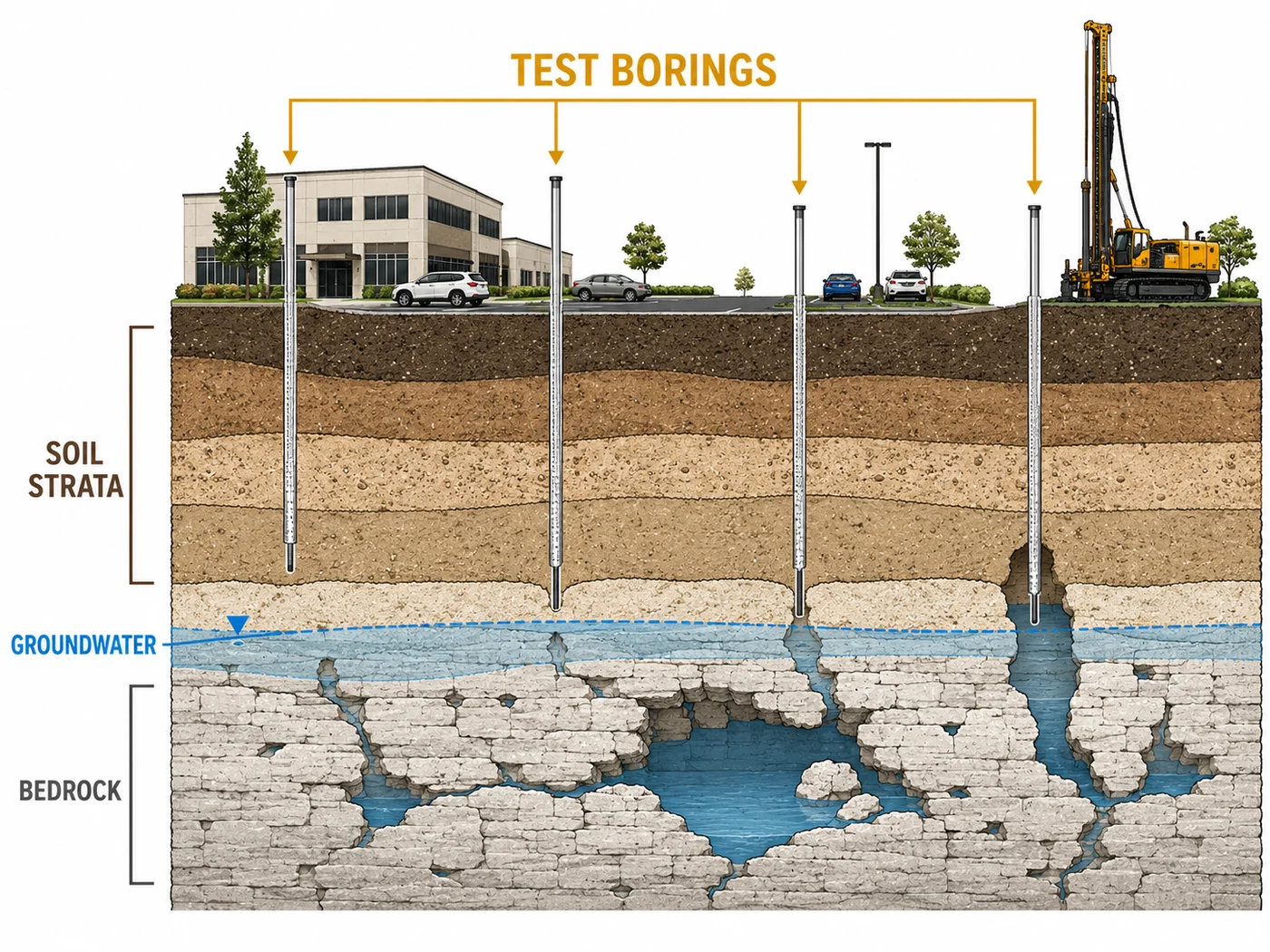
Most states have a predictable geological profile. Florida does not. The peninsula sits atop the Florida Platform, a thick sequence of carbonate rocks — predominantly limestone and dolomite — deposited over tens of millions of years. The Floridan Aquifer System, one of the largest and most productive aquifer systems in the world, occupies this carbonate matrix.
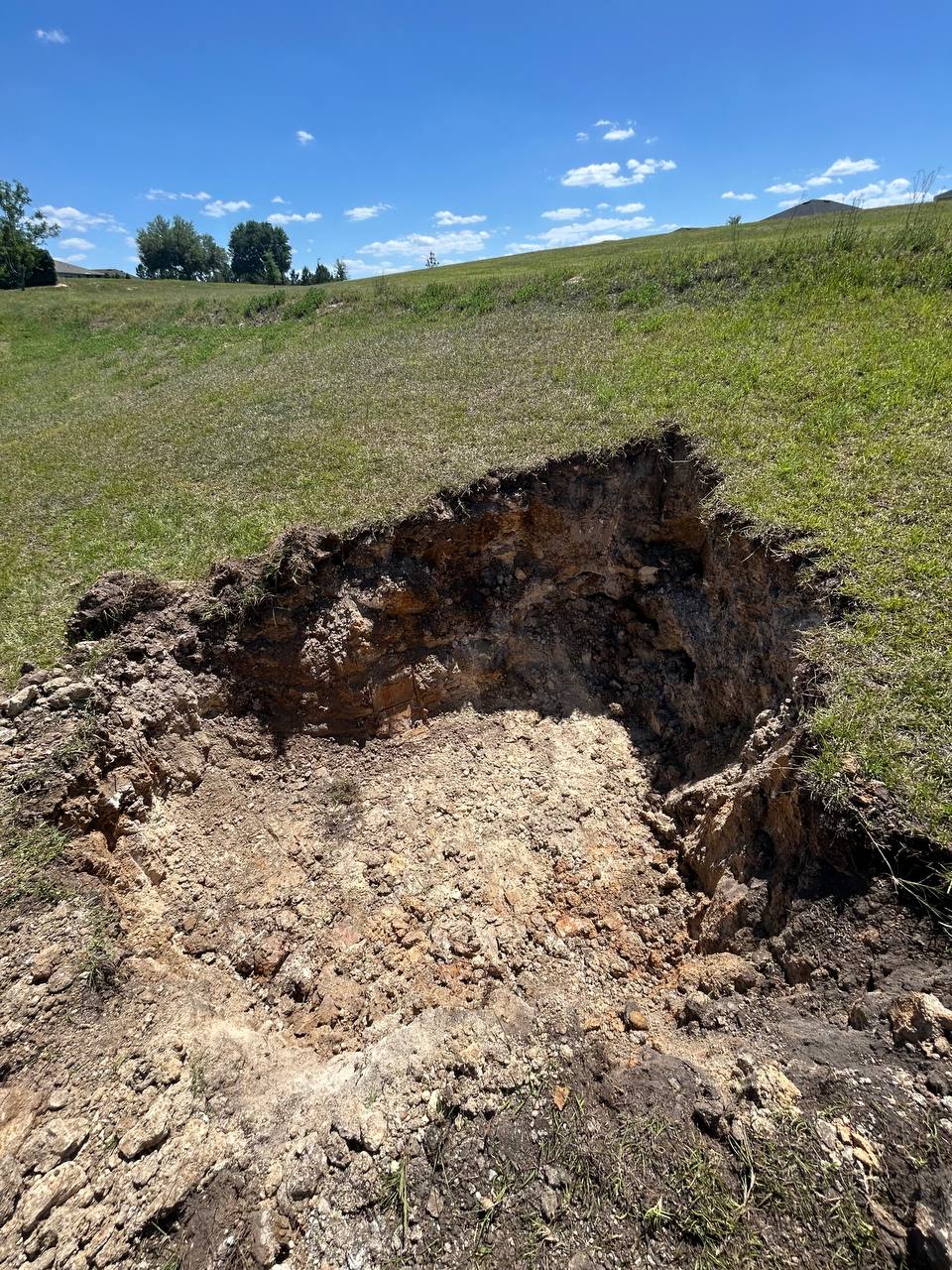
Dissolution of limestone by slightly acidic groundwater creates voids, conduits, and weakened zones throughout Florida’s subsurface. Central Florida — including Pasco, Hernando, Marion, Hillsborough, Sumter, and Citrus counties — sits within the most sinkhole-prone region in the United States. A geotechnical investigation in these areas must specifically assess karst features. Our Sinkhole Investigation & Evaluation service addresses this in detail.
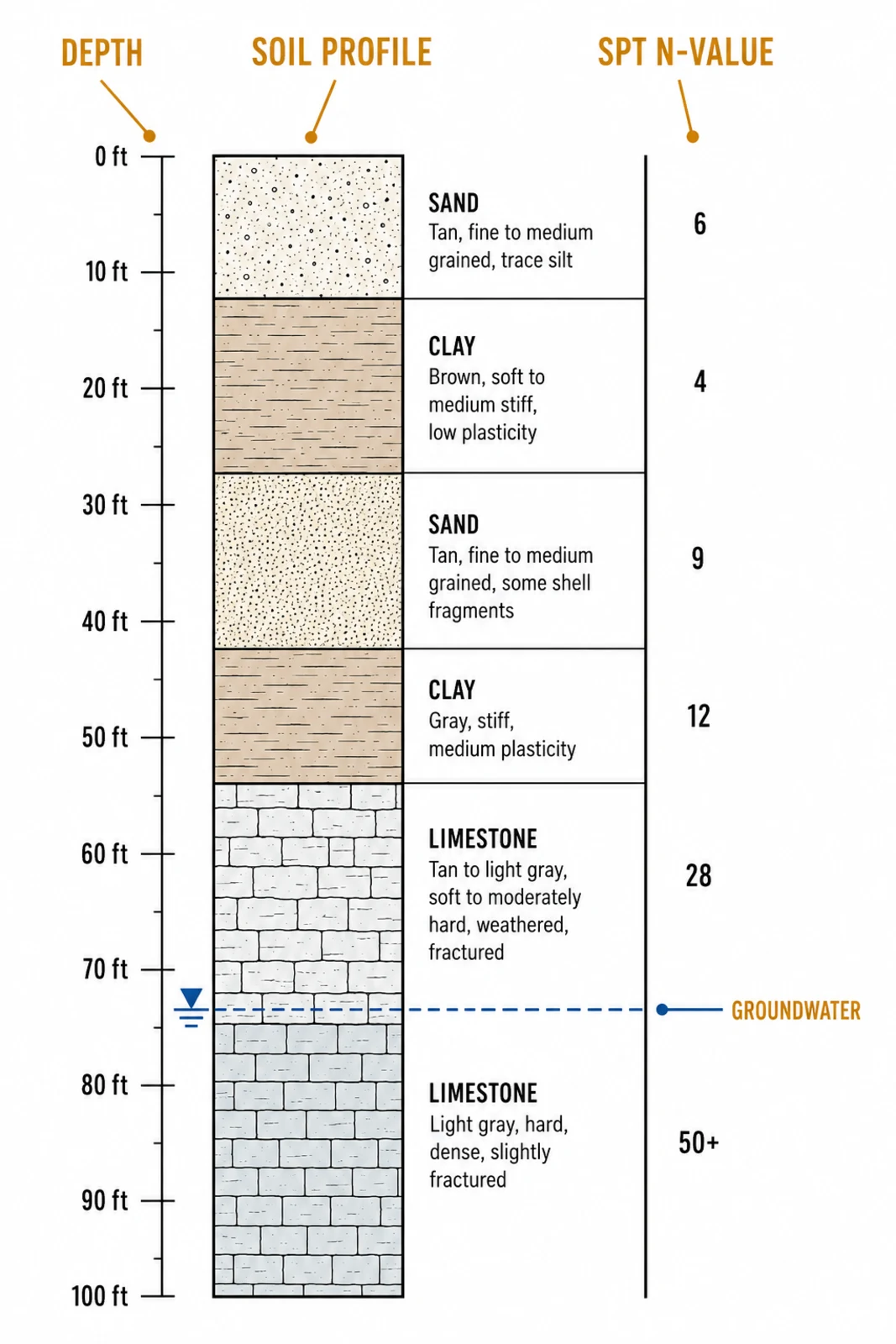
Across much of peninsular Florida, the near-surface geology consists of fine-grained sands that are typically cohesionless, loose to medium-dense, with low natural bearing capacity. Standard Penetration Tests (SPT) quantify the in-situ density profile and allow engineers to specify appropriate footing dimensions or alternative foundation systems such as driven piles, auger-cast piles, or deep helical piles.
Florida averages 54 inches of rainfall per year. Seasonal water tables are shallow across most of the peninsula — often within 2 to 6 feet of the surface during the wet season. High water tables affect excavation stability, foundation drainage, earthwork compaction specifications, and buoyancy design of below-grade structures.
Florida’s building code imposes wind design requirements among the strictest in the country. Deep foundation systems in coastal and high-wind zones must be designed for significant uplift and lateral loads in addition to axial compression — addressing soil-pile lateral resistance, p-y curves, and drilled shaft capacities that account for scour and storm surge.
Much of developed coastal Florida was historically marsh, wetland, or low-lying scrub. Development has resulted in significant areas of placed fill of variable quality, plus undisturbed peat and organic muck layers at shallow depths. These materials are highly compressible and can cause long-term settlement that exceeds the tolerance of structural elements by orders of magnitude.
FGS provides geotechnical engineering services for a broad range of project types:
Municipal and infrastructure work in Florida frequently requires compliance with FDOT Soils and Foundations Handbook standards and AASHTO LRFD Bridge Design Specifications. Our Construction Materials Testing team also provides the ongoing QA/QC testing required during construction.
Every FGS investigation moves through four well-defined phases — from desktop site review to a stamped engineering report. Here’s how we work.
Before a drill rig mobilizes, FGS reviews USGS topographic maps, NRCS Web Soil Survey data, FDEP sinkhole database records, FEMA flood maps, and any prior geotechnical reports for the site. This desktop review identifies known hazards and informs the scope of the field investigation.
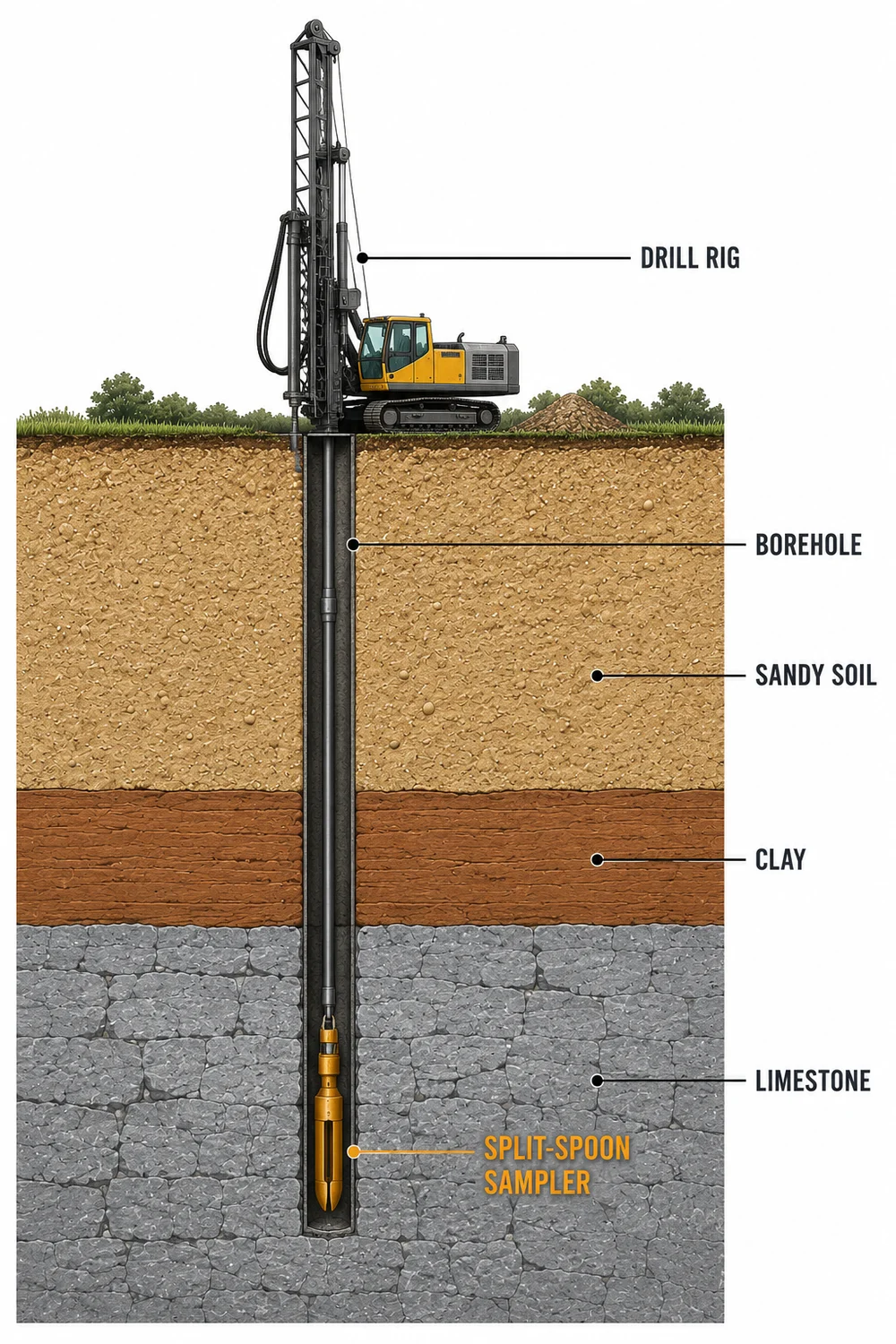
Field work consists of Standard Penetration Test (SPT) borings advanced using hollow-stem auger or rotary wash methods. SPT borings provide a continuous record of subsurface stratigraphy and N-values at five-foot intervals. Full drilling capabilities →
Samples go to FGS’s FDOT- and CMEC-accredited in-house laboratory in Ocala. Standard tests include moisture content, grain size analysis, Atterberg limits, soil classification, organic content, and Proctor compaction. Lab capabilities →
FGS’s licensed engineers perform bearing capacity calculations, settlement analysis, pile capacity estimates, lateral load analysis, and slope stability assessment. The deliverable is a written, PE-stamped geotechnical engineering report.
FGS was founded by Ryan Townsend, whose 28-year career in Central Florida geotechnical work spans residential subdivisions, commercial campuses, FDOT roadway projects, sinkhole investigations, and municipal infrastructure. That depth of local experience matters in ways that can’t always be quantified.
Our Senior Project Engineer, David Cappa, P.E. (Florida P.E. #58334), brings an additional 45+ years of geotechnical engineering experience to FGS — including FDOT prequalifications in Work Groups 9.1, 9.2, 9.3, and 9.4.1. Dave is the engineer of record on FGS’s geotechnical investigation reports, sinkhole evaluations, and foundation engineering studies.
Our laboratory is both FDOT and CMEC accredited. We do not subcontract laboratory work, which means faster turnaround, direct chain-of-custody control, and a single point of accountability from field sampling through lab results to engineering analysis. The result: FGS consistently delivers reports and field results faster than our competitors — industry-leading lead times that keep your project on schedule.
FAQ
The cost of a geotechnical report in Florida depends on the number of borings required, boring depths, laboratory testing scope, and whether specialized methods like GPR or CPT are included. For a typical single-family residential lot, a report with two to three borings and standard lab testing generally ranges from $1,500 to $3,500. Commercial sites requiring six or more deep borings and extensive lab testing typically range from $5,000 to $20,000 or more, depending on complexity. Contact FGS at (352) 619-9292 for a project-specific proposal.
Requirements vary by county and project type. Many Florida counties — including Marion, Alachua, Hillsborough, and Pasco — require a geotechnical report for commercial projects and, increasingly, for residential construction in sinkhole-prone areas. FDOT-let roadway and bridge projects always require a geotechnical investigation. Even where not strictly required, a geotechnical report protects the owner and design team from liability and is typically required by construction lenders.
For a typical residential or small commercial project, FGS can typically mobilize for field work within five to ten business days of notice to proceed, complete field work in one to two days, and deliver a final report within three to four weeks of fieldwork completion. Larger projects, specialty testing (CPT, rock coring, GPR), or expedited delivery can be arranged — contact us to discuss your schedule.
The two terms are often used interchangeably. A geotechnical report (sometimes called a soil investigation report, geotechnical investigation report, or foundation investigation report) is the formal engineering document produced by a licensed geotechnical engineer that includes boring logs, laboratory data, and engineering recommendations. A "soils report" in the context of a Florida building permit typically refers to the same document.
FGS is based in Ocala and has deep expertise in Central Florida, but we provide services statewide. We have completed projects throughout Marion, Alachua, Putnam, Levy, Citrus, Hernando, Pasco, Hillsborough, Orange, Osceola, Polk, Lake, Sumter, Flagler, and surrounding counties. Contact us to discuss project locations outside Central Florida.
Get started
Tell us about your project and we'll get right back to you. Industry-leading turnaround on stamped reports, fieldwork, and lab results.
Prefer to talk? (352) 619-9292
Thanks — we've got it and we'll be in touch within one business day.
Need it now? Call (352) 619-9292.
Statewide service area
FGS delivers geotechnical engineering across Central and North Florida from our Ocala lab. Explore the service in the communities we cover most: