Accreditation That Matters
FDOT and CMEC accreditation. The acronyms that decide whether your results get accepted on an FDOT-let project or by your lender. Without them, you’re paying for testing that doesn’t count.

Concrete · Asphalt · Soils · Aggregate
FDOT & CMEC accredited construction materials testing in Florida. Concrete, asphalt, soils & aggregate. Industry-leading turnaround. Call (352) 619-9292.
FDOT CMEC Accredited · ACI-Certified Techs · Statewide
CMT is the work that doesn’t make the news until something fails. Concrete, asphalt, soils, aggregate — tested by accredited methods so the failure happens on paper at the lab, not in year three on your project.
FDOT and CMEC accreditation. The acronyms that decide whether your results get accepted on an FDOT-let project or by your lender. Without them, you’re paying for testing that doesn’t count.
ACI-certified field technicians plus current FDOT credentials for the test methods they run. The right reading from the gauge matters; so does the tech knowing when the reading is wrong.
Field reports within 24–48 hours. Lab results in 5–7 days. Same-day accept/reject on time-sensitive pours and paving. Slow reports mean problems get covered up before they get caught.
Construction materials testing is the quiet work that decides whether the bridge holds, whether the parking lot makes it past year five without alligator cracking, whether the slab cures to the strength the engineer specified. Nobody notices CMT when it’s done right. Everyone notices it when it isn’t.
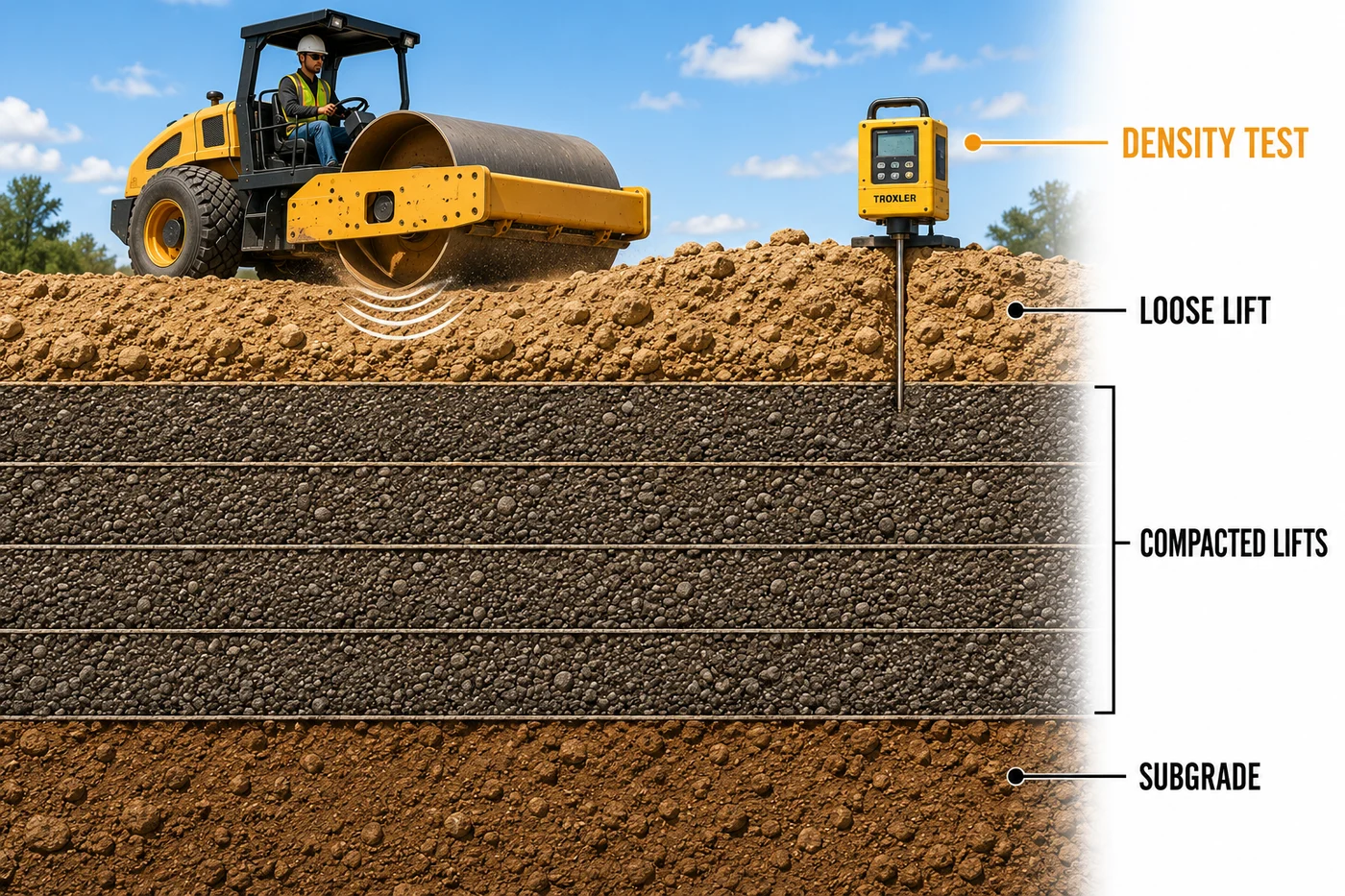
After enough years on enough projects, you stop being surprised at what gets caught by good testing — and what gets missed by bad testing. A cylinder that breaks at half its specified strength three weeks after the pour. A nuclear gauge reading on a fill that says 92% Modified Proctor when it should be 95%, telling the contractor to rework the lift before the asphalt goes down on top of it. An asphalt extraction showing the binder content is two percent low on a batch the plant said was on spec. The job of CMT is to find those problems before they get buried under the next pour.
FGS runs CMT services from our Ocala base — concrete, asphalt, soils, aggregate — supported by an FDOT- and CMEC-accredited in-house lab. ACI-certified technicians in the field, current FDOT credentials for the test methods on FDOT projects. Field reports out within a day or two, lab results within a week. Documentation that gets accepted by building officials, FDOT project engineers, and lenders the first time, because it’s set up the way they expect.
Two things, mostly — field testing and lab testing.
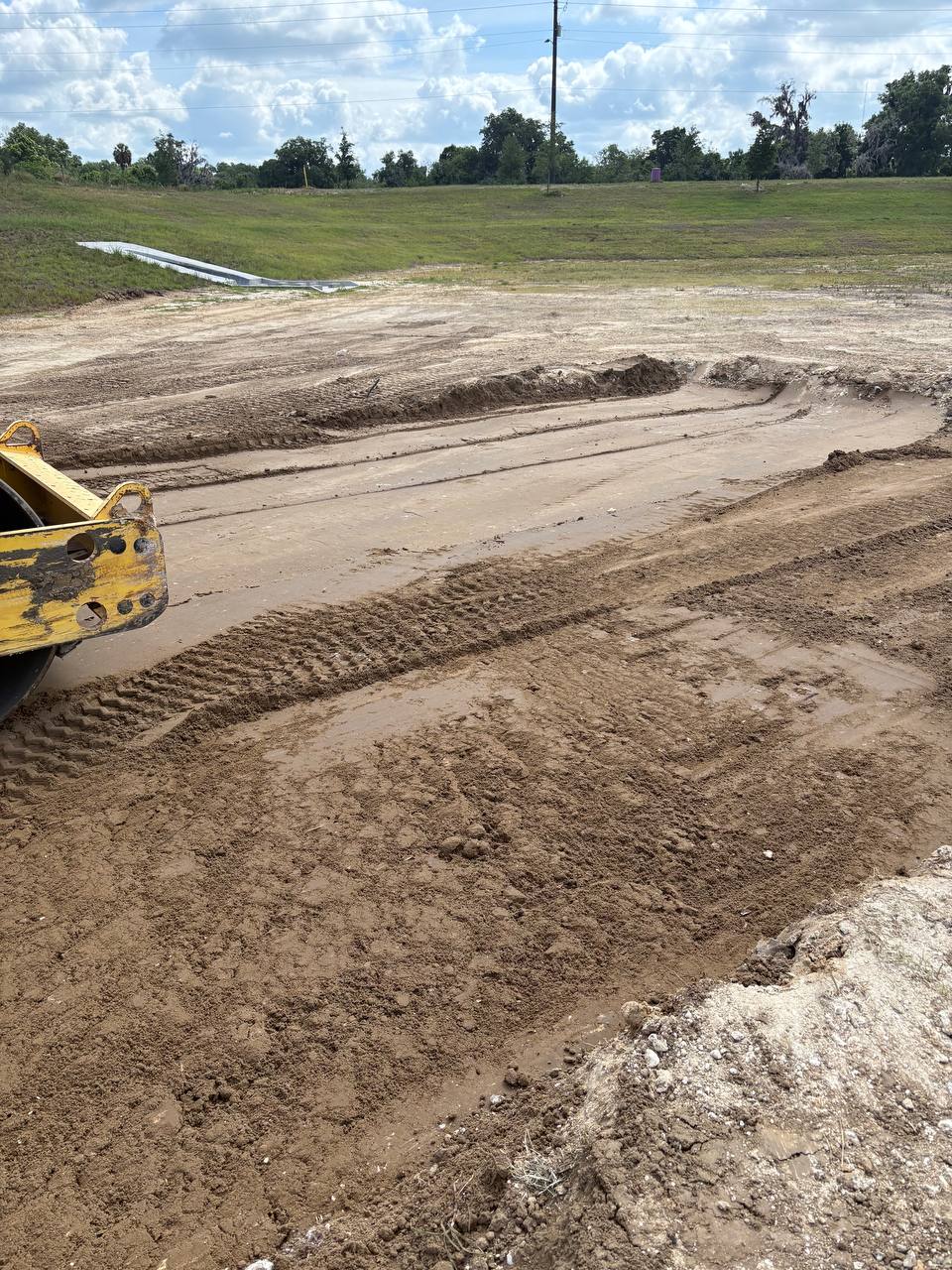
Field testing happens at the construction site while work is active. A technician shows up, samples the freshly placed concrete, runs slump and air content, measures temperature, casts cylinders. Or runs nuclear density gauge readings behind the paver as the asphalt mat goes down. Or measures the density of a compacted subgrade lift before the contractor moves to the next lift. The point is immediacy — if a concrete load fails slump at the truck, it gets rejected before placement. If a compacted lift doesn’t hit density, the contractor reworks it before the next lift covers the evidence. Real-time testing is the only kind that lets you fix the problem instead of just documenting it.
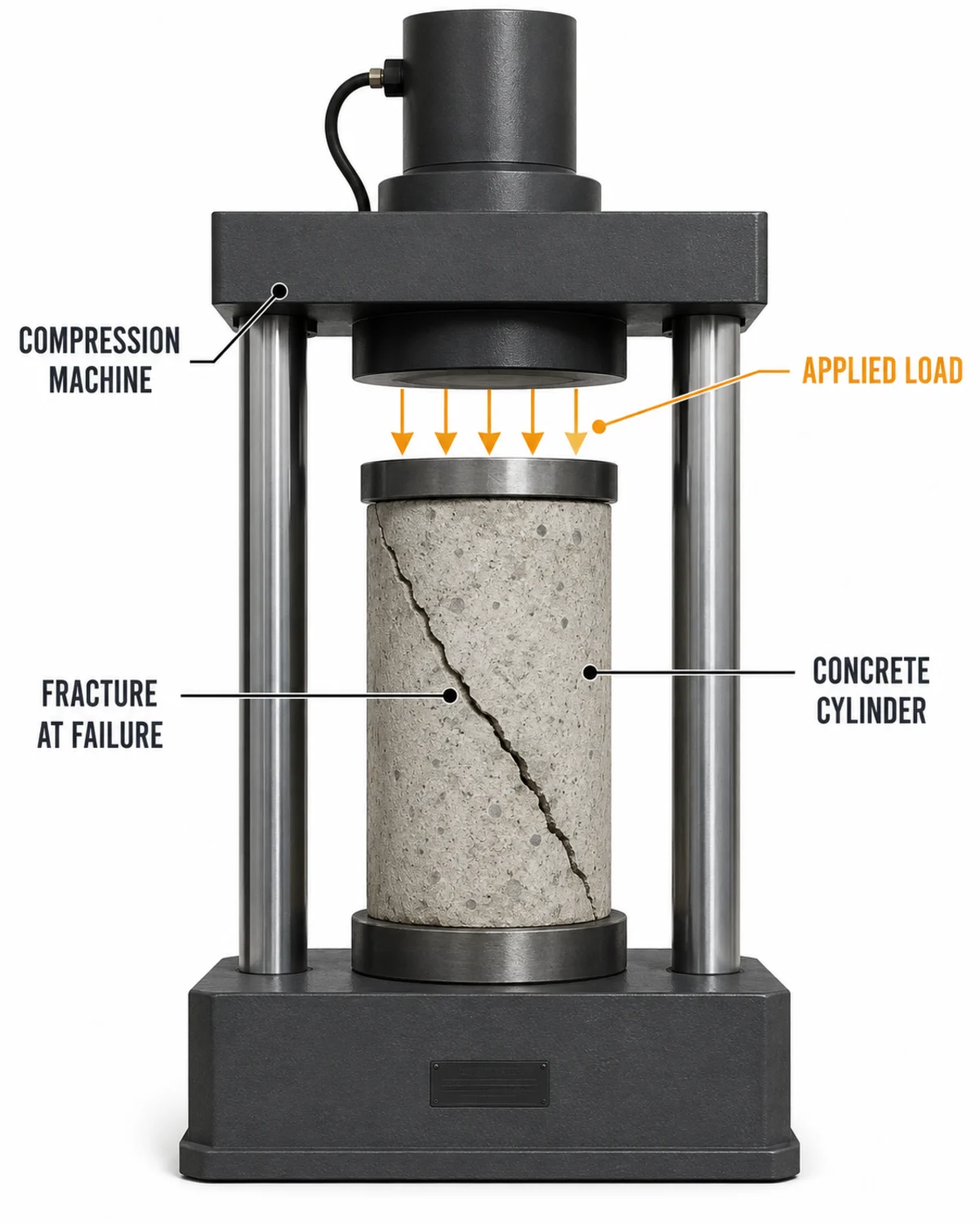
Laboratory testing happens later, on samples brought back to the lab. Concrete cylinders cast in the field get cured under controlled conditions and broken in compression at 7 and 28 days. Asphalt cores and loose mix samples go through extraction, gradation, and Marshall stability or Superpave volumetric analysis. Soil samples produce Proctor density curves that set the reference for field compaction acceptance. Lab work confirms what field testing screened for and provides the documented record the building official, FDOT engineer, or lender needs.
The FBC requires that structural concrete meet specified compressive strength verified by cylinder break testing per ACI 318. Special inspections under Chapter 17 mandate that concrete placement, masonry, high-strength bolting, welding, and other critical work be observed and documented by qualified special inspectors. On commercial and multi-family work, this isn’t optional.
On FDOT-let work — highways, bridges, interchanges, rest areas — the FDOT Standard Specifications prescribe exactly what gets tested, how often, by whom, and to what acceptance criteria. FDOT only accepts results from accredited laboratories with certified technicians. There is no “close enough” lane. If the lab isn’t accredited for the test method, the result doesn’t count and the work doesn’t get paid.
Construction lenders and owner’s reps routinely require independent CMT documentation as a condition of draw disbursement. They want evidence that the contractor is building to spec. The documentation has value years later if something fails — and zero documentation has zero defensive value.
Even on projects where code and FDOT don’t require it, prudent owners specify CMT anyway. The math is simple: testing usually runs a fraction of a percent of project cost. Reworking a failed pour, replacing under-compacted fill that settled, or repairing pavement that didn’t last because the subgrade wasn’t right — those costs are an order of magnitude bigger. CMT is the cheapest insurance on the job.
Concrete, asphalt, soils, aggregate. All tested by ASTM, AASHTO, ACI, and FDOT methods. All processed through the same in-house lab so the chain of custody stays tight and the results come back fast.
Slump (ASTM C143), air content (C231/C173), temperature (C1064), unit weight (C138). Cylinders cast in the field per C31, cured under standard conditions, broken in compression at 7 and 28 days (C39). Flexural beams (C78) for pavement concrete. ACI-certified field techs run the show. Full concrete testing →
Nuclear density gauge per ASTM D2950, core sampling for definitive density acceptance, Marshall stability (D6927), Superpave gyratory compaction. Asphalt extraction (D2172/D5444) and ignition oven testing (D6307) to verify binder content and gradation against the job mix formula. Full asphalt testing →
Nuclear density gauge (D6938) for routine compaction control. Sand cone (D1556) where nuclear is restricted or for referee work. Standard and Modified Proctor (D698/D1557) to set the density reference. Limerock Bearing Ratio (LBR per FDOT FM 5-515) for FDOT subgrade acceptance. Lab capabilities →
Sieve analysis (C136/D6913) for coarse and fine aggregate gradation. Sand equivalent (D2419) for fine dust content. Fractured face count (D5821) for crushed particle content. Sodium sulfate soundness (C88) for weathering resistance. LA abrasion (C131/C535) for degradation resistance.
FGS runs CMT on the full range of Florida construction:
For big projects we can put a dedicated tech on site for continuous coverage during critical phases. For smaller jobs we schedule periodic testing to the inspection plan. Either way, our techs talk to the field — they don’t show up, sample, and disappear.
Every CMT activity gets documented on a standardized field report: date, location, material, test method, results, technician signature. Field reports out within 24 to 48 hours of testing. Lab reports follow as testing completes. For Chapter 17 Special Inspection programs, FGS can serve as the Special Inspector of Record and provide the threshold inspection reports and final letter of compliance the AHJ needs. Documentation set up the way Florida building officials expect — because we’ve delivered it to them enough times to know what they’re looking for.
Send us the project — scope, schedule, who’s the AHJ, who’s the lender. We’ll tell you what testing it needs, what we’d charge, and how fast we can be on site. FDOT & CMEC accredited. ACI-certified techs. Real reports, on time.
FAQ
Not every one, but most. Florida Building Code Chapter 17 mandates special inspections for structural concrete, masonry, and other elements on commercial and multi-family buildings — that's not optional. FDOT contracts specify testing frequencies for every material. Construction lenders typically require it as a draw condition. Even on small commercial projects where it's not strictly required, most design engineers and owners specify it because the cost of testing is a fraction of the cost of fixing what testing would have caught.
It means FDOT has evaluated the lab's facilities, equipment calibration records, procedures, and personnel against their specific test method standards — and the lab passed. Accredited labs get re-evaluated periodically; you can't pass once and coast. Without accreditation, test results from a lab aren't accepted on FDOT-let projects, no matter how good the work actually is. FGS holds current FDOT accreditation across all applicable test categories.
24 to 48 hours for routine work — that gives us time to schedule a tech without scrambling. For big concrete pours or multi-day paving operations, a week of advance notice lets us assign the right person and confirm equipment. That said, we get same-day and next-day requests all the time for urgent situations, and we accommodate them when we can. Call (352) 619-9292 — we'll tell you straight whether we can cover it.
FDOT accreditation is the Florida Department of Transportation's program for labs working on state-let projects — facility, equipment, procedures, and personnel evaluated against FDOT-specific test method standards. CMEC (Construction Materials Engineering Council) is an independent national accreditation body recognized by most state DOTs and federal agencies. Holding both means our results are accepted across the widest range of public and private project requirements. FGS holds current accreditation under both programs.
Both. For public work, our FDOT and CMEC accreditations cover the submittal requirements. For private work, we tailor the testing program to the project specifications and the owner's QA/QC standards. Same lab, same techs, same standards — different paperwork on the back end depending on the project type.
Get started
Tell us about your project and we'll get right back to you. Industry-leading turnaround on stamped reports, fieldwork, and lab results.
Prefer to talk? (352) 619-9292
Thanks — we've got it and we'll be in touch within one business day.
Need it now? Call (352) 619-9292.
Statewide service area
FGS delivers construction materials testing across Central and North Florida from our Ocala lab. Explore the service in the communities we cover most: