Statute 627.707 Compliant
Reports built to the methodology and certification standard the statute requires — defensible for insurance, neutral evaluations, and disputed claims, for insurers and owners alike.

Florida Statute 627.707 Compliant · Insurance & Engineering Grade
Sinkholes scare people — Florida has more of them than any other state. But most of what gets reported as "sinkhole activity" isn't. The only way to know which is which is to do the work properly: GPR, borings, lab, engineering judgment. We've done a few.
Reports built to the methodology and certification standard the statute requires — defensible for insurance, neutral evaluations, and disputed claims, for insurers and owners alike.
GPR survey, SPT borings, rock coring, accredited lab — each method validates the others. GPR alone doesn't meet the standard, no matter what anyone tells you.
From mobilization to stamped report. In-house lab, so samples don't sit in a shipping container for a week. Expedited turnaround when the claim timeline demands it.
The honest version
No geological hazard in Florida generates more fear than the sinkhole — and for good reason. Florida leads the nation in sinkhole activity; the Florida Geological Survey has documented thousands. But here's what nobody in marketing wants to admit: most of what gets reported turns out to be normal settlement, a leaky drain undermining a slab, wood-frame movement from humidity, or a bad fill compaction from the original construction.
You can't know which it is until somebody does the work — and it has to be done a specific way. Florida Statute 627.707 spells out the methodology: GPR first, then SPT borings to ground-truth what GPR found, then lab testing, then engineering judgment from a licensed professional. Skip steps and the report doesn't hold up — not in court, not in neutral evaluation, not in front of any reviewer who knows what to look for.
FGS does sinkhole investigations the way the statute intends. We've worked both sides of the dispute — for carriers running primary investigations, and for owners contesting findings they thought were wrong. Either way, the methodology is the same. The integrity of the work is the same.
Why Florida
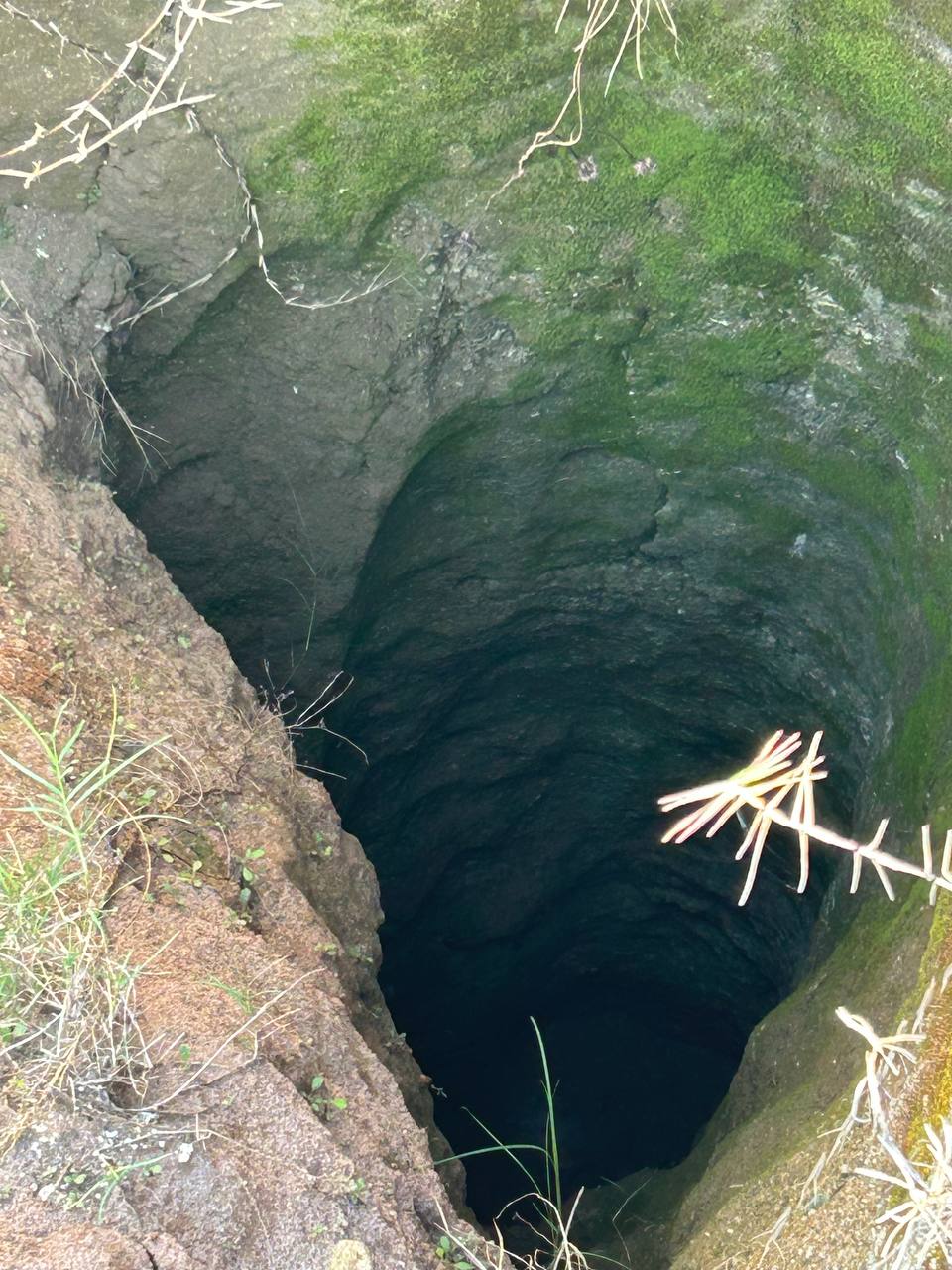
Most of the peninsula sits on Ocala Limestone — also the Floridan Aquifer System. Slightly acidic groundwater has been eating at that rock for tens of millions of years, forming voids and conduits invisible from the surface. The part most people miss: those voids rarely reach the surface. What reaches the surface is what happens when the sand-and-clay overburden, after years of bridging a void, finally gives up. That collapse is the sinkhole — and the void below has often been growing for a long time.
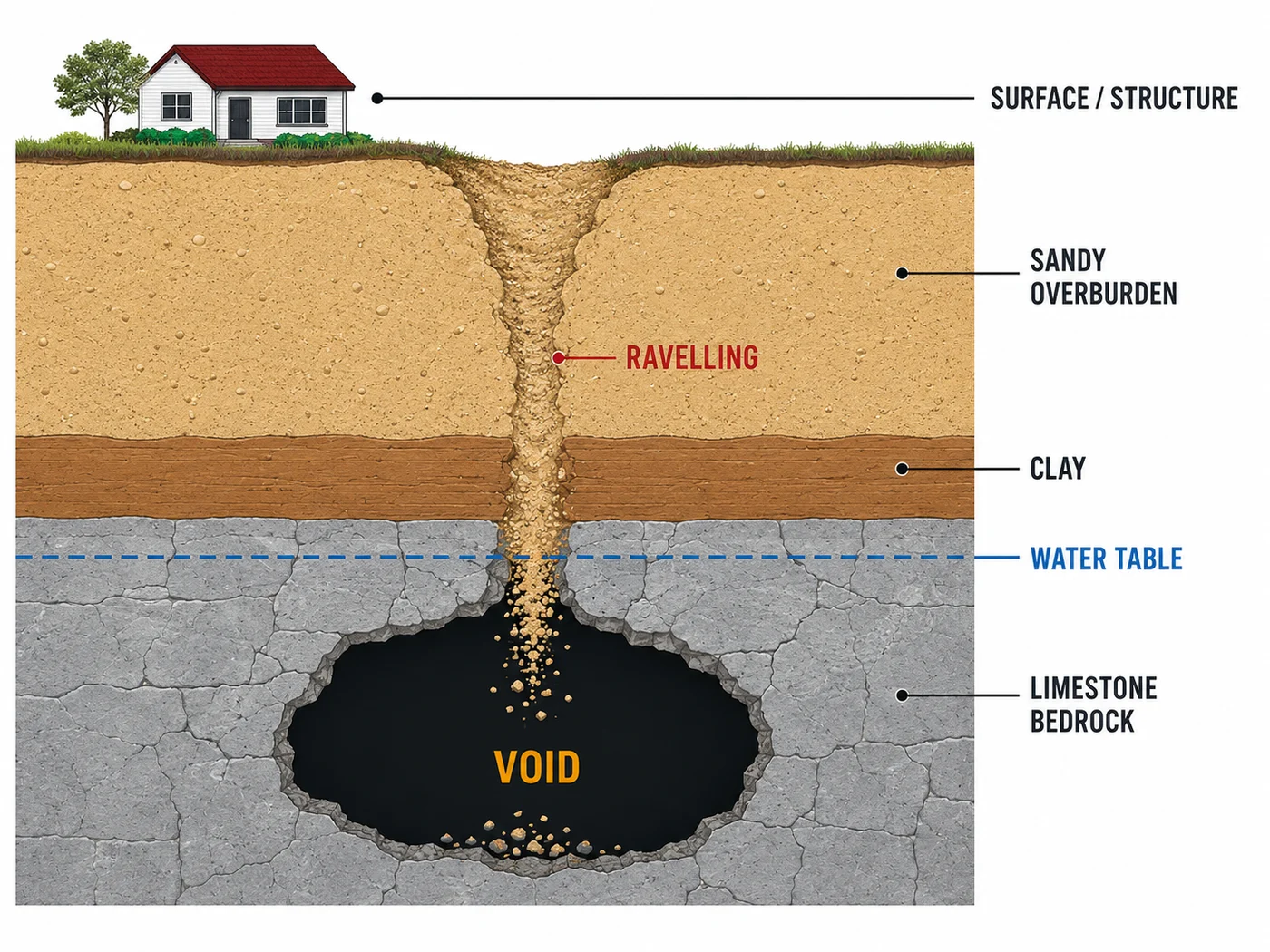
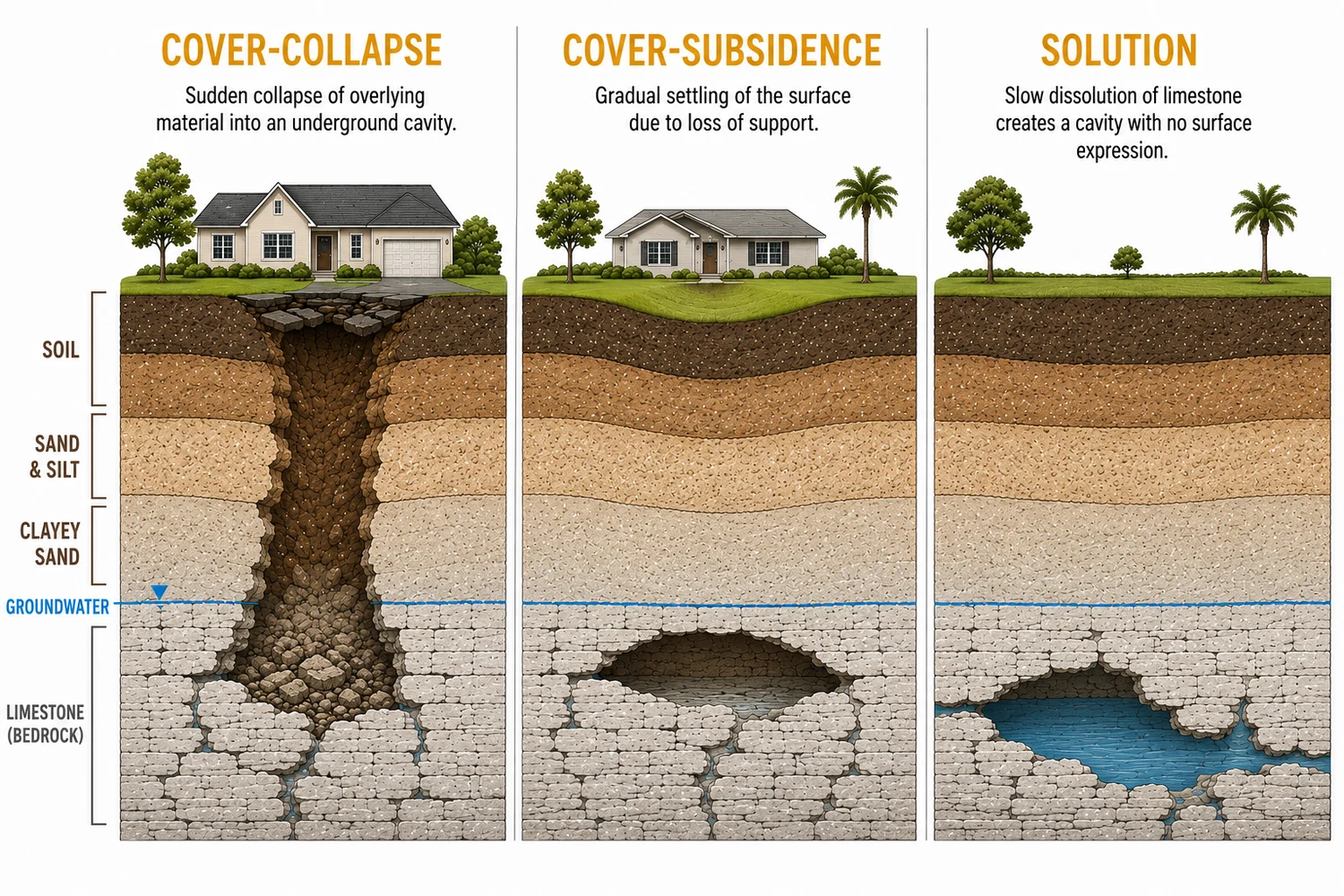
Three flavors, very different behavior
Form where limestone is exposed or thinly covered. Slow, gradual widening — common in the karst-window areas of north-central Florida.
Sandy overburden slowly migrates downward through openings in the rock. Saucer-shaped depressions and progressive distress — the slab that cracks year after year with no dramatic event.
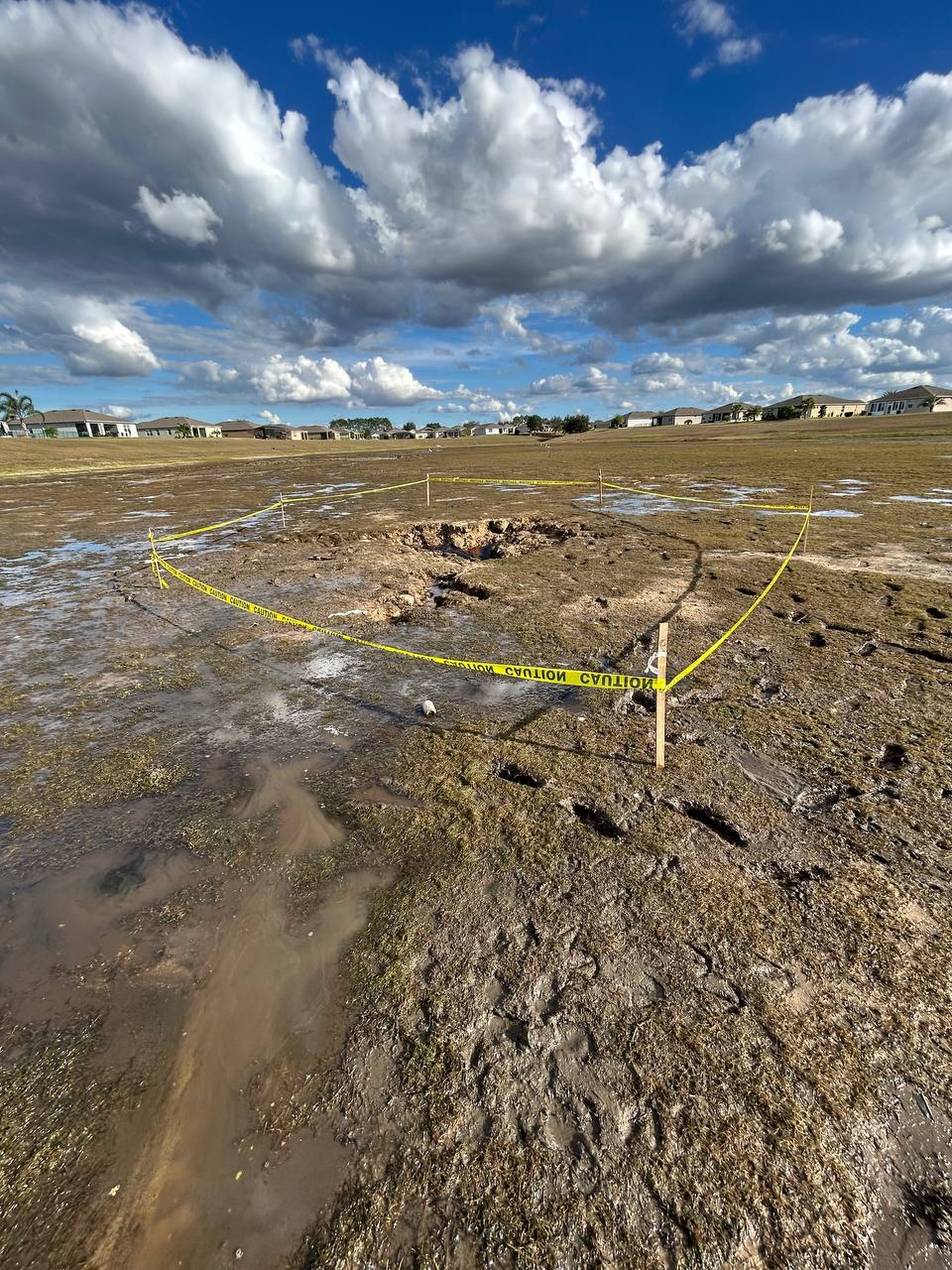
The dramatic, news-making kind. Cohesive clay arches over a void for years, then fails suddenly. Seffner (2013) and Winter Park (1981) were cover-collapse events.
The highest-activity corridor runs along I-4 and north through Pasco, Hernando, Marion, and Citrus — locals call it Sinkhole Alley. But risk exists wherever limestone sits close to the surface and the water table swings seasonally, which is most of the state.
Signs worth taking seriously
Diagonal cracking at window and door corners — especially cracks that come back after repair
Floor separating from baseboards or walls, or a noticeable slope or depression in the floor
Additions, garages, or porches pulling away from the main structure
Circular depressions in the yard that form or grow, particularly after heavy rain
Fence posts or utility lines leaning without an obvious surface cause
Doors and windows that suddenly stick after years of working fine
Turbid or discolored well water after drought, heavy rain, or nearby dewatering
One of these in isolation usually means nothing. Two or three showing up around the same time, in the same area of the house, and progressing — that's when we'd recommend a professional evaluation. Don't panic. Don't ignore it either.
The rulebook
The statute exists because too many investigations were getting cut short to save money — by carriers and homeowner-hired firms alike — and the reports weren't holding up. So Tallahassee laid down a methodology. Insurers writing residential property policies must investigate sinkhole claims using a licensed professional engineer or geologist, following specific methods, defining "sinkhole activity" and "sinkhole loss" the way the statute defines them, to the degree of professional certainty it requires.
FGS provides evaluations that comply fully with 627.707 — documenting methodology, results, and conclusions in the required format, suitable from primary investigation through neutral evaluation. We can also be retained by an owner who disagrees with their carrier's conclusions. Sometimes the carrier got it right and we'll tell you so. Sometimes they missed something and we'll find it. Either way the work is independent, and the report stands on its own merit.
Four methods, in this order, for a reason
GPR alone doesn't meet the statute. Borings alone miss what GPR would catch. The combination is what produces a report that holds up.
GPR comes first because it's fast and non-invasive — a quarter-acre lot in a half-day, identifying voids, raveling, pinnacled rock, and soil anomalies. It doesn't tell you what's there; it tells you where to look.
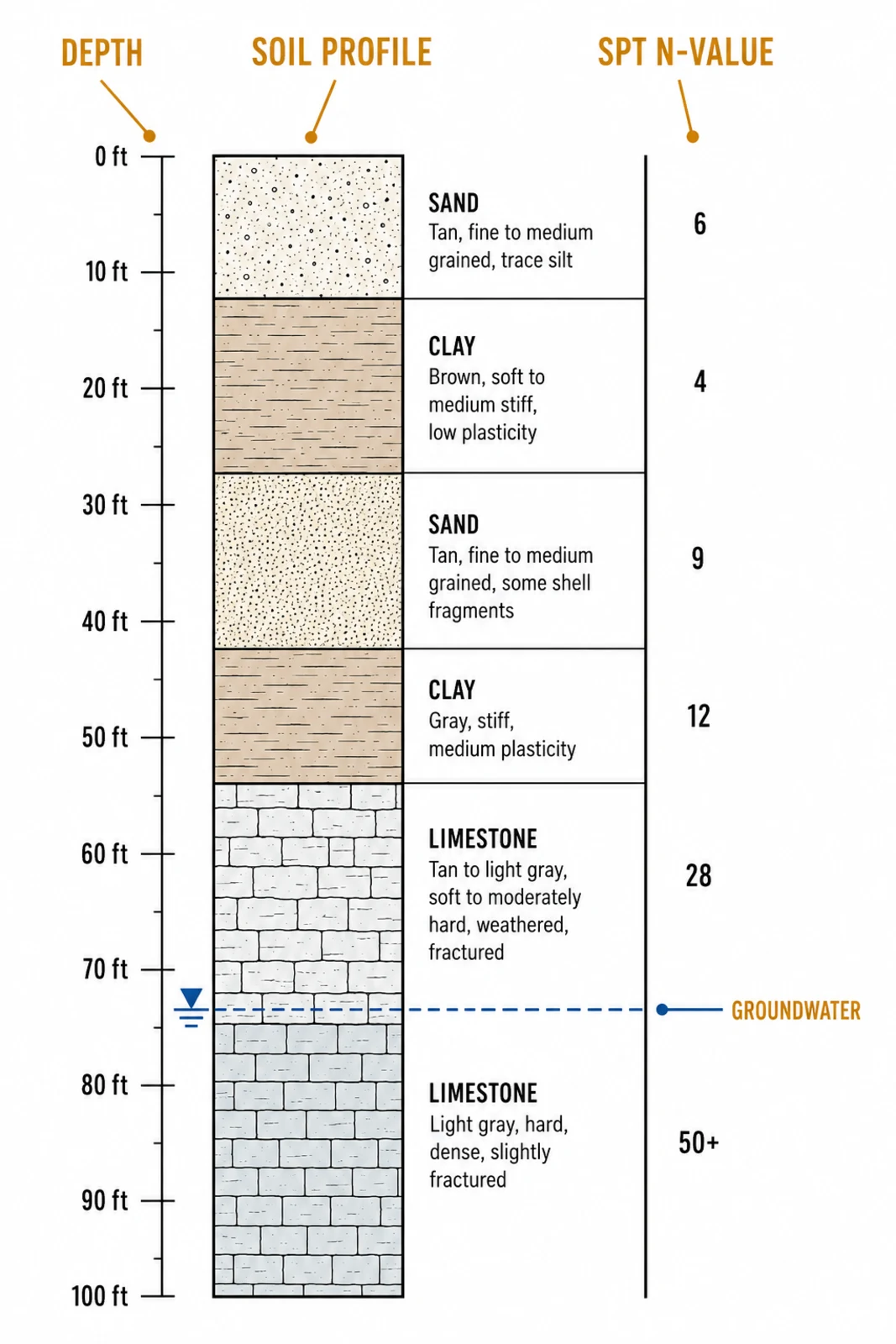
More on GPR →Then we drill. Borings advance through the overburden into the limestone, recording N-values at five-foot intervals — confirming GPR findings and catching what it can't see: soft zones, raveling, depth to competent rock.
Drilling methodology →Where drilling resistance suggests a complex karst profile, we core the rock. Diamond bits recover intact samples; RQD values quantify fracturing and weathering. Low recovery in solid limestone is direct evidence of karst — no way to fake it.
Samples go to our accredited Ocala lab — grain size, Atterberg limits, moisture, organics. The lab data integrates with field observations to support the engineering conclusion.
Lab menu →The deliverable
After the fieldwork and lab analysis, FGS's licensed engineer assembles the report. Every one covers six things — not to pad page count, but because the statute and the underlying engineering both require them.
When activity is confirmed
Three remediation tools — and most real projects use a combination, not just one.
The workhorse. Stiff, low-mobility grout pumped under pressure at closely spaced points displaces and densifies loose soil — the most widely used remediation for the most common failure mode: overburden raveling.
Low-viscosity grout fills voids and stabilizes loose soil. Used in finer-grained soils where compaction grouting alone wouldn't densify the matrix.
Piles or helical piers driven through the affected soil into competent limestone, transferring structural load past the trouble zone. Used when settlement must be arrested immediately.
FGS doesn't write the recommendation and walk away. We monitor the grouting program — pre- and post-remediation borings to verify the densification target was hit, with our CMT team supporting QA/QC. Independent verification by the same engineer who designed the recommendation is hard to argue with. How our sinkhole grouting monitoring works →
Where we work
These counties are where most of our work happens — but we'll work anywhere in Florida there's a sinkhole question.
Ocala, Dunnellon, Belleview, Silver Springs
Brooksville, Spring Hill, Weeki Wachee
New Port Richey, Land O'Lakes, Zephyrhills, Dade City
Crystal River, Inverness, Homosassa
Tampa, Brandon, Plant City
St. Petersburg, Clearwater, Largo
Gainesville, Newberry
The Villages, Wildwood
FAQ
For a residential property, typically a GPR survey (1–2 hours of fieldwork), then 2–4 SPT borings advanced to 60–80 feet (one to two days of drilling), then 3–5 days of lab testing, then 5–10 days of engineering analysis and report writing. Three to five weeks total, mobilization to stamped report — faster if the claim timeline demands it.
Yes. Florida Statute 627.707 requires insurers offering sinkhole coverage to investigate reported claims using a licensed professional engineer or geologist, with defined methods and a defined standard for determining activity. If you disagree with the carrier's findings, you can request a neutral evaluation and retain your own engineer. We've done both.
No. GPR can screen a property for anomalies, but it can't confirm or rule out sinkhole activity — it sees boundaries between materials, not what the materials are. The only way to know is to drill into the anomaly. A GPR-only report wouldn't meet 627.707 or hold up in a proceeding. If somebody offers a sinkhole 'investigation' without drilling, ask them why.
Settlement is soil compressing under load or shrinking from moisture loss. Karst sinkhole activity is soil migrating into dissolution voids in the underlying limestone — a different mechanism with a different distress pattern. The distinction matters because insurance covers one and typically not the other, and the remediation is completely different. Telling them apart takes a professional engineering evaluation, not surface guesswork.
A standard residential investigation — GPR, SPT borings, lab testing, stamped report — runs $3,500 to $7,500 depending on lot size and boring depths. Commercial and multi-family work is quoted site-specifically. Call (352) 619-9292 with the property details and we'll give you a real number.
Statewide service area
FGS runs Statute 627.707-compliant sinkhole investigations across Central and North Florida from our Ocala lab. Sinkhole Alley counties are a core part of our work:
Early investigation beats emergency response, every time. We'll tell you what we see — even if it turns out not to be a sinkhole. 627.707-compliant reports, industry-leading turnaround.