Sinkhole investigation where depressions, cracking, or suspect boring data point to active karst — typically a combination of GPR screening and targeted SPT borings
Home / Geotechnical Engineering Gainesville FL
Geotechnical engineering, SPT borings, and soil testing for Gainesville & Alachua County from our Ocala office and accredited lab. Call (352) 619-9292.
SERVING GAINESVILLE ALACHUA COUNTY FROM OCALA
Gainesville sits on one of the sharpest geological boundaries in Florida: clay-rich Hawthorn Group uplands on one side, near-surface karst limestone on the other. Two sites a few miles apart can need completely different foundations. We run SPT borings, lab testing, and stamped geotechnical reports for Alachua County projects from our Ocala office, about 45 minutes down I-75.
Alachua County is divided by the Cody Scarp, an old marine escarpment that separates two fundamentally different subsurface regimes. To the northeast, the Hawthorn Group — a Miocene sequence of phosphatic clays, clayey sands, and carbonates — blankets the limestone and confines the Floridan aquifer. To the southwest, erosion has stripped the Hawthorn away, and Ocala Limestone sits within a few feet of the surface under a thin sand cover.
That boundary runs through the Gainesville area. It is why the county has both Devil’s Millhopper — a 120-foot-deep karst window in the city’s northwest — and clay hills where sinkholes are rare but plastic soils cause their own problems.
On the Hawthorn side, the issues are clay issues. Hawthorn clays can be highly plastic, with shrink-swell behavior that cracks slabs and flexes shallow footings as moisture changes seasonally. Water perches on the clay layers, so a site can show a wet-season water table well above the regional aquifer, which matters for stormwater design and below-grade construction. Bearing conditions can change over short horizontal distances as the clay surface undulates.
On the karst side — western Alachua County, out toward Newberry, Archer, Jonesville, and High Springs — the limestone surface is shallow, pinnacled, and irregular. The Floridan aquifer is unconfined here. Dissolution of the limestone by slightly acidic groundwater has left solution features, raveling zones, and soft soil pockets in the sand cover above the rock. In SPT borings these show up as sudden drops in N-values, weight-of-rod intervals, or lost drilling fluid circulation. Devil’s Millhopper is the famous example, but small features that never make the news are common in this part of the county.
Then there is Paynes Prairie: a large karst basin that drains through Alachua Sink, ringed by organic soils and soft fine-grained deposits. Sites near the prairie margin can carry several feet of compressible material that has no business under a slab. Organics do not improve with compaction. They have to be found, quantified, and either removed or designed around.
Which of these worlds your site sits in changes the foundation type, the earthwork budget, and sometimes the project economics. You cannot tell from the parcel map. You can tell from borings.
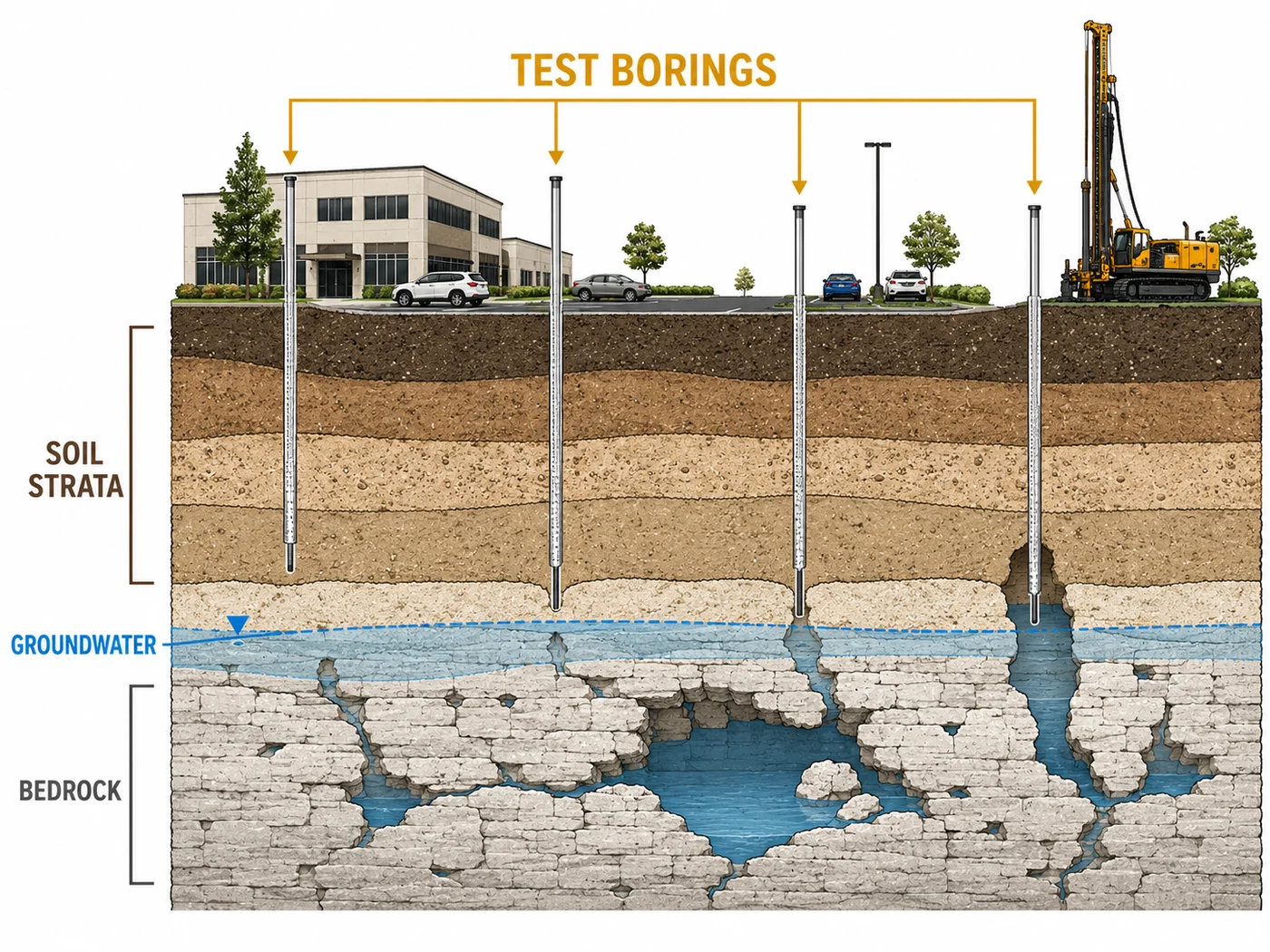
The core of our Gainesville work is subsurface exploration and the engineering that follows from it. Our drill crews run SPT and auger borings to the depths the structure and the geology demand — deeper where karst is suspected, because the problems in western Alachua County are often below the depth a minimal boring program would reach. Samples go to our in-house accredited soil laboratory for classification, moisture, Proctor compaction, and whatever index or strength testing the project needs. The result is a geotechnical report with foundation recommendations, signed and sealed by a Florida-licensed P.E.
Beyond standard site exploration, Alachua County projects regularly call for:
Sinkhole investigation where depressions, cracking, or suspect boring data point to active karst — typically a combination of GPR screening and targeted SPT borings
Foundation engineering for structures that cannot use conventional shallow footings, including sites near Paynes Prairie with organic or soft soils
Phase I environmental site assessments for infill and redevelopment parcels, which in Gainesville often have a prior commercial or industrial history
Construction materials testing during earthwork and foundation construction — field density tests, concrete sampling, and the special inspections Chapter 17 of the Florida Building Code requires for certain structures
The full scope of what we offer statewide is on our geotechnical engineering services page. Not every Gainesville project needs all of it. A single-family addition usually needs a couple of borings and a short report. A multifamily podium building near campus needs considerably more.
Gainesville’s construction market is shaped by the university. Student housing and multifamily projects cluster near campus on infill parcels that have been built on before — which means old fill, buried foundations, and demolition debris in the upper soil profile. Borings through uncontrolled fill are exactly where you want honest data before you pour, because fill that was never compacted to a Proctor standard settles under load, and it settles unevenly.
We work for civil engineers and architects who need a stamped geotechnical report to move their design forward, for general contractors who need density testing and materials testing during construction, for developers doing due diligence before closing on land, and for homeowners with settlement cracks who want to know whether they are looking at normal differential settlement or something karst-related. Building departments in the area commonly ask for a signed and sealed geotechnical report on new commercial construction, and lenders and insurers sometimes drive the request on residential work.
We are based in Ocala at 302 SW 33rd Ave, about 45 minutes from Gainesville. That is close enough that mobilization is not a cost driver the way it is for firms coming from Jacksonville or Orlando, and close enough that a field crew can be on an Alachua County site without a multi-week scheduling lead.
A typical project runs: scope call and proposal, utility locates, drilling, lab testing, then the engineering report. Because the laboratory is in-house, samples do not sit in a shipping queue. For a standard commercial site exploration, the report is typically in your hands two to three weeks after drilling, often faster — and we will tell you up front if the drill schedule or the scope pushes that.
One thing we will not do is overstate what the data shows. A boring tells you about the soil column at that boring. Karst is irregular by nature, and no economically feasible boring program proves the absence of a void between borings. What a good program does is characterize the site conditions, flag the warning signs, and give the design team defensible numbers — allowable bearing capacity, settlement estimates, groundwater levels — with the limits stated plainly.
FAQ
Residential work — additions, settlement evaluations, single-lot reports — typically runs $1,500 to $3,500 depending on the number and depth of borings. Commercial site explorations typically run $5,000 to $20,000+ depending on building footprint, structural loads, and required boring depths. Western Alachua County sites sometimes cost more than the equivalent project elsewhere because suspected karst justifies deeper borings, and depth is the main cost driver in drilling.
Part of it is. Sinkhole risk in Alachua County tracks the geology: it is highest southwest of the Cody Scarp, where Ocala Limestone is shallow and the Floridan aquifer is unconfined, and lower in the Hawthorn-covered uplands to the northeast, where the thick clay sequence buffers the surface from dissolution features in the rock below. Devil’s Millhopper is the dramatic local example of what the western county’s geology can produce. If you are dealing with suspected sinkhole damage to an insured home, Florida Statute 627.707 governs how those insurance claims are investigated; an independent geotechnical investigation tells you what is actually under the house.
It depends on the footprint, the loads, and the geology — there is no fixed code formula for boring counts, though building departments and structural engineers in the area commonly expect borings at building corners and interior column locations for commercial work, taken to a depth governed by the foundation loads. On the karst side of the county we generally recommend deeper borings than the structural minimum, because the features that damage buildings there are often in the limestone and the raveled soil just above it, not in the upper fifteen feet. We will give you a boring plan and the reasoning behind it before any drilling is scheduled.
In-house. We operate an accredited soil and materials laboratory in Ocala, so classification testing, Proctors, LBR for pavement work, and concrete testing all happen under our roof. That matters for turnaround — no shipping samples and waiting on a third party’s queue — and it matters for accountability, because the engineer signing your report works in the same building as the lab producing the numbers.
Get started
Tell us about your project and we'll get right back to you. Industry-leading turnaround on stamped reports, fieldwork, and lab results.
Prefer to talk? (352) 619-9292
Thanks — we've got it and we'll be in touch within one business day.
Need it now? Call (352) 619-9292.
Serving Gainesville & Alachua County
Every FGS service line is available throughout Gainesville & Alachua County — fieldwork, drilling, and our in-house accredited lab, all from Ocala: