ACI & FDOT Credentialed
ACI Concrete Field Testing Technician Grade I and Concrete Strength Testing Technician certifications. FDOT-method asphalt testing experience. The credentials your specs require and inspectors expect.

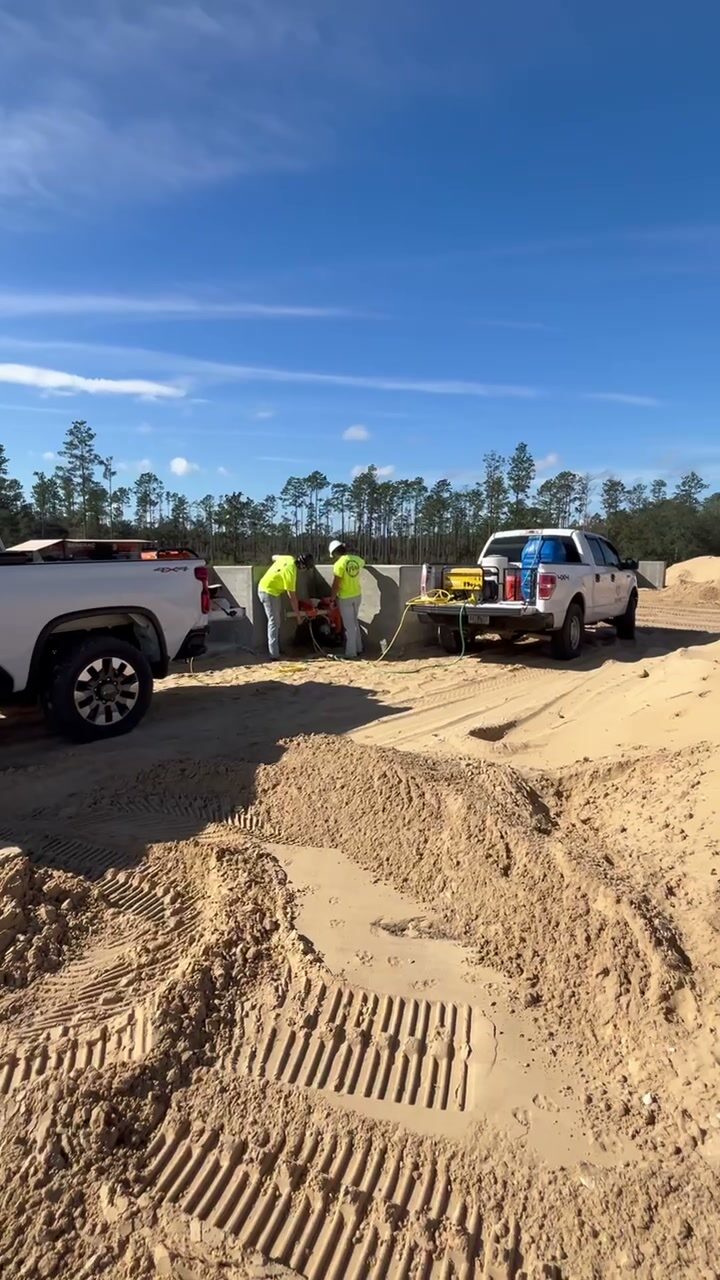
Cylinder Breaks · Superpave · Density Coring
ACI-certified concrete testing plus FDOT-method asphalt verification across Florida. Cylinders, cores, gradation, Superpave QC/QA. Call (352) 619-9292.
ACI-Certified · FDOT-Method · ASTM AASHTO Compliant
Cylinders, cores, slump, air, density, gradation, asphalt content. The materials testing that decides whether what got delivered to the site is what was specified — and that catches the bad batch before it ends up under your building.
ACI Concrete Field Testing Technician Grade I and Concrete Strength Testing Technician certifications. FDOT-method asphalt testing experience. The credentials your specs require and inspectors expect.
Pour scheduling moves. We move with it. Most placement testing requests get a tech mobilized the same day or next morning. The break results come back when the specifications say they should — not three weeks later.
A failed cylinder isn’t a problem until it’s been investigated. Borderline air content isn’t a rejection until it’s been engineered against the spec. Every non-compliance gets reviewed by a P.E. — not just flagged on a form.
Concrete and asphalt are the two materials that build almost everything — buildings, roads, bridges, parking lots, foundations. They’re both designed in a lab, batched at a plant, and delivered to a job site where the actual properties can drift from the design in any number of ways: water added to the truck because it’s looking stiff, asphalt cooling in transit, aggregate gradation off-spec at the plant, air content lost during pumping.
Testing is the only thing that closes the gap between “this is what we specified” and “this is what we got.” Fresh concrete tests catch problems while the material is still in the truck. Cylinder breaks catch problems in time to do something about them. Asphalt density testing catches placement temperature and compaction issues before the section gets covered. Every test is a checkpoint. Every checkpoint is cheap compared to what it would cost to discover the problem after the building is up.
FGS performs ACI-certified concrete field and lab testing across Florida — typically in support of our broader Construction Materials Testing programs — plus FDOT-method asphalt mix verification, gradation, asphalt content, and density testing. Every report is reviewed and signed where appropriate by a Florida P.E.
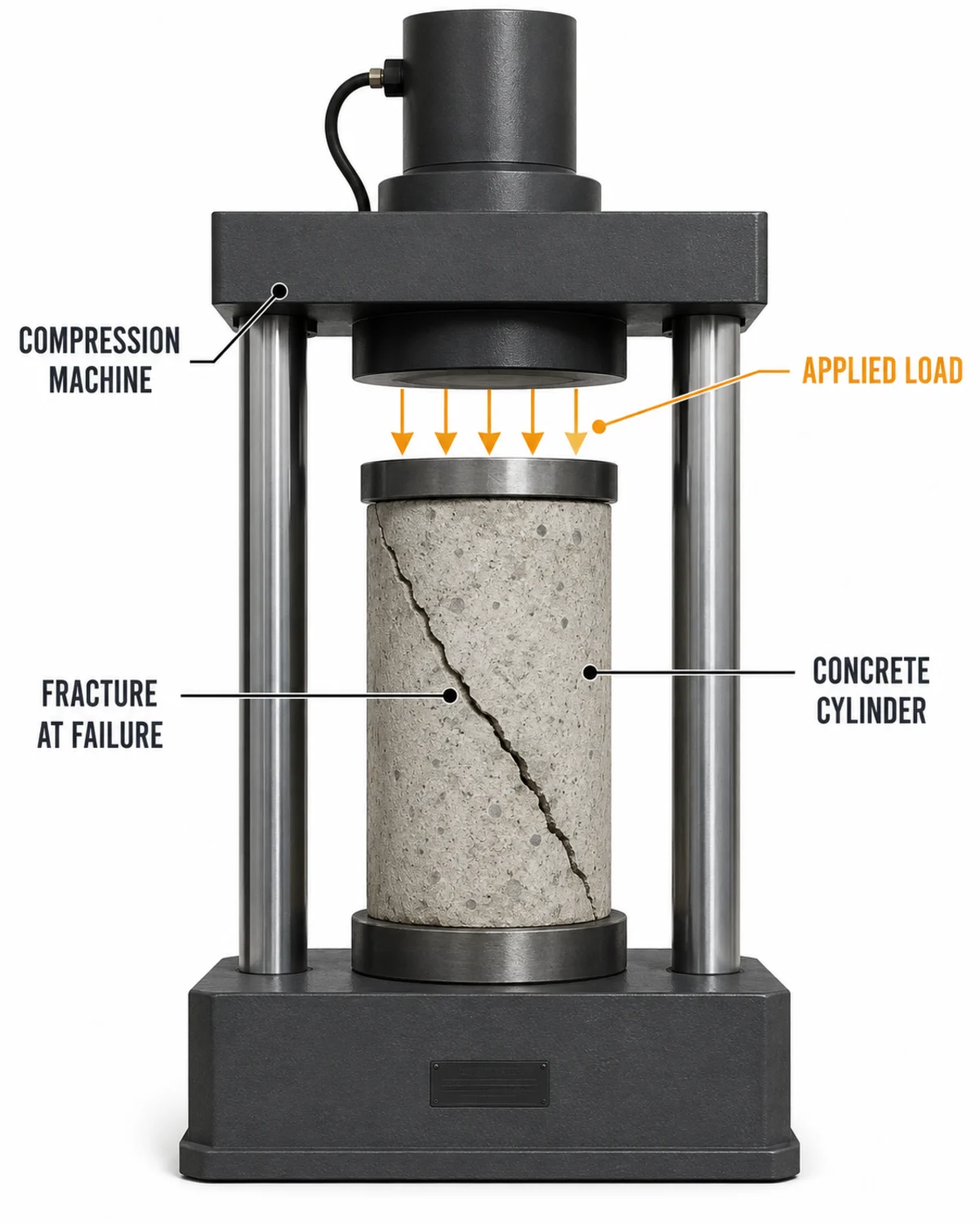
Concrete is a chemical reaction between cement and water that produces heat as it cures. In Florida summer, the ambient temperature is already high and the slab temperature can climb past 100°F before the truck even leaves the plant. Hot weather concrete placement isn’t a special case here — it’s most of the year.
ACI 305 — the hot weather concreting standard — exists because hot concrete behaves differently. Set time accelerates. Water demand goes up. Plastic shrinkage cracks form before the slab is finished. The mix designs that work for an October pour don’t necessarily work for an August pour without adjustments — retarders, lower cement content, ice in the mix water, or sub-cooling the aggregate. The field testing we do — slump, temperature, air content, and unit weight on every truck — catches the drift from spec while the material is still placeable.
Florida also uses limestone coarse aggregate almost exclusively — locally quarried, cheap, structurally fine. But limestone aggregate produces different curing behavior than the granite or gravel aggregates other parts of the country rely on. The mix design has to account for it. The testing has to verify it. The reports have to document it.
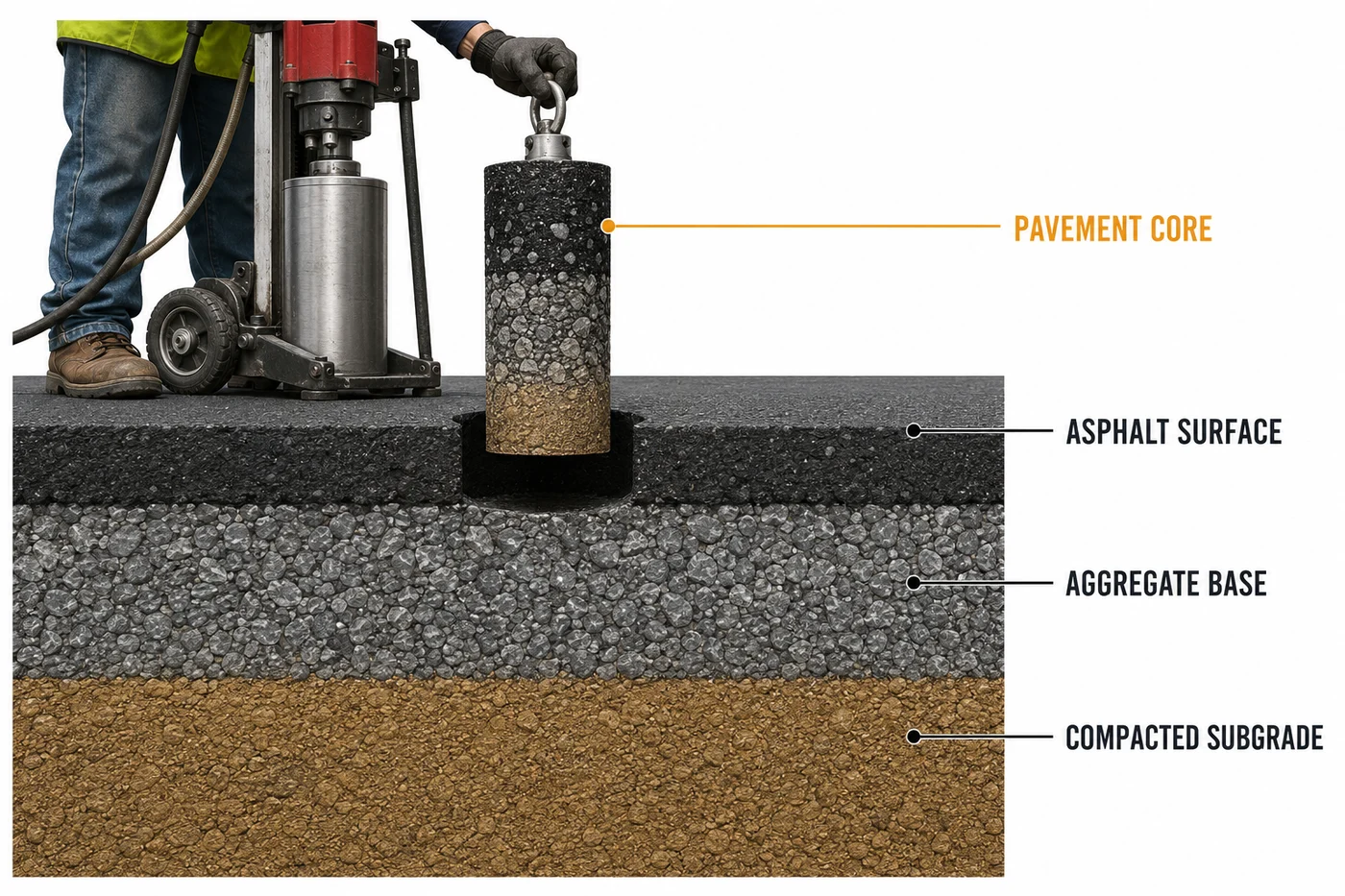
Field testing happens at the placement. Lab testing happens after. Both halves get reviewed against the project specifications — and when results drift, the report says so plainly, with what the engineer recommends to do about it.
Slump (ASTM C143), air content (C231 pressure / C173 volumetric), temperature (C1064), unit weight (C138), cylinder casting (C31). Standard battery on every truck or every 50 yards for routine work; tightened frequency on critical structural elements. Field reports the same day; cylinder logs maintained for the project life.
Compressive strength on cylinders (C39) at 7, 14, 28, and 56 days as specified. Flexural strength (C78) for pavement and structural plate work. Modulus of elasticity (C469), splitting tensile (C496), and rapid chloride permeability when service-life durability matters. Core testing (C42) when in-place strength verification is needed.
Gradation by extraction (AASHTO T 30), asphalt content (T 308 ignition oven), bulk specific gravity (T 166), maximum theoretical specific gravity / Rice (T 209), Marshall stability where applicable, Superpave gyratory compaction (T 312) for FDOT mix verification.
Nuclear density gauge testing (ASTM D2950) during placement to verify compaction in real time. Core extraction (D979) for post-placement verification. Density results compared to control strip or maximum theoretical density per the project specification — failures flagged immediately so corrective rolling can still happen.
A failed cylinder is not automatically a failed pour. ACI 318 explicitly addresses low strength results — investigation, core testing, structural analysis. The conversation is structured, the engineering path is well-defined, and a non-compliant test result is the start of an evaluation, not the end of a project.
Same with asphalt density. A first-pass low density reading triggers an investigation of placement temperature, rolling pattern, and underlying support — not an automatic rip-up. Sometimes the density is low because the mix is segregated; sometimes because the rollers got off pattern; sometimes because the underlying base is too soft to compact against. The diagnosis dictates the correction. The diagnosis is engineering, not test-runner reaction.
When non-compliance shows up in our testing, the report explains what failed, where the result fell relative to the spec, what the most likely causes are, and what additional testing or analysis we recommend. Reports go out fast — contractors and structural engineers need them in time to act. The goal is not to dunk on the placement; the goal is to figure out what to do next.
General contractors and CMs running concrete and asphalt scopes on commercial, industrial, institutional, and multifamily projects.
Structural engineers requiring documented compliance with project specifications and the Florida Building Code Chapter 17 special inspection requirements.
Civil engineers and developers on parking lot, private road, and site civil pavement programs.
Municipal owners and FDOT contractors running QC/QA programs on roadway and infrastructure work.
Building owners and property managers investigating in-place concrete strength or hardened pavement condition on existing assets.
The work is straightforward to scope. Tell us the project, the spec, the schedule, and the expected pour or placement volumes — we’ll quote a testing program that meets the requirements without padding it.
Concrete pour testing, hardened core analysis, asphalt mix verification, or FDOT QC/QA — tell us the project and we’ll scope the right testing program with a quote inside 48 hours. Same-day mobilization. Industry-leading lead times.
FAQ
The specification controls. The default ACI 318 frequency is one strength test per 150 cubic yards or one per 5,000 square feet of slab area, whichever requires more tests, with a minimum of one test per day. Florida Building Code Chapter 17 special inspections often tighten that on structural pours. We follow what the spec requires — not less, but not 3× more just to inflate testing volumes.
Almost never on the first low result. ACI 318 lays out an explicit evaluation path: review the test record, investigate causes, take cores from the suspect area if needed, perform a structural evaluation considering the actual core strength. A pour comes out only when in-place strength can't be reconciled with the original design intent through analysis or supplemental investigation. Most low cylinder breaks resolve through that process without removal.
For most commercial structural work, yes — at least for the placements that get tested. The technician verifies the truck ticket, performs fresh tests, casts cylinders, and observes placement conditions. For lower-risk work (sidewalks, light pavements) with looser specifications, frequency can be reduced or batch-sampled. The project spec and the structural engineer's expectations dictate; we'll scope to those.
7-day breaks the same day they're tested; 28-day breaks the same day. Reports go out within 24 hours of testing — typically same-day for time-sensitive work where the contractor needs to know whether to keep placing on top. We don't sit on results until end of week. Industry-leading turnaround is one of the reasons clients keep our number on speed dial.
Yes. The FDOT asphalt test battery — gradation, asphalt content by ignition, gyratory compaction, bulk specific gravity, maximum theoretical (Rice), in-place density by nuclear or cores — is part of our standard scope. Dave's FDOT Work Group certifications cover the roadway geotechnical and lab testing categories required for QC/QA participation. Contractors running FDOT projects use our lab as part of the project-required testing program.
Get started
Tell us about your project and we'll get right back to you. Industry-leading turnaround on stamped reports, fieldwork, and lab results.
Prefer to talk? (352) 619-9292
Thanks — we've got it and we'll be in touch within one business day.
Need it now? Call (352) 619-9292.
Statewide service area
FGS delivers concrete & asphalt testing across Central and North Florida from our Ocala lab. Explore the service in the communities we cover most: