Crews That Know Florida
Decades drilling Central Florida. When an auger feels different at 28 feet, when the rock surface is pinnacling, when circulation is about to drop into a void — our drillers notice. New crews don’t.

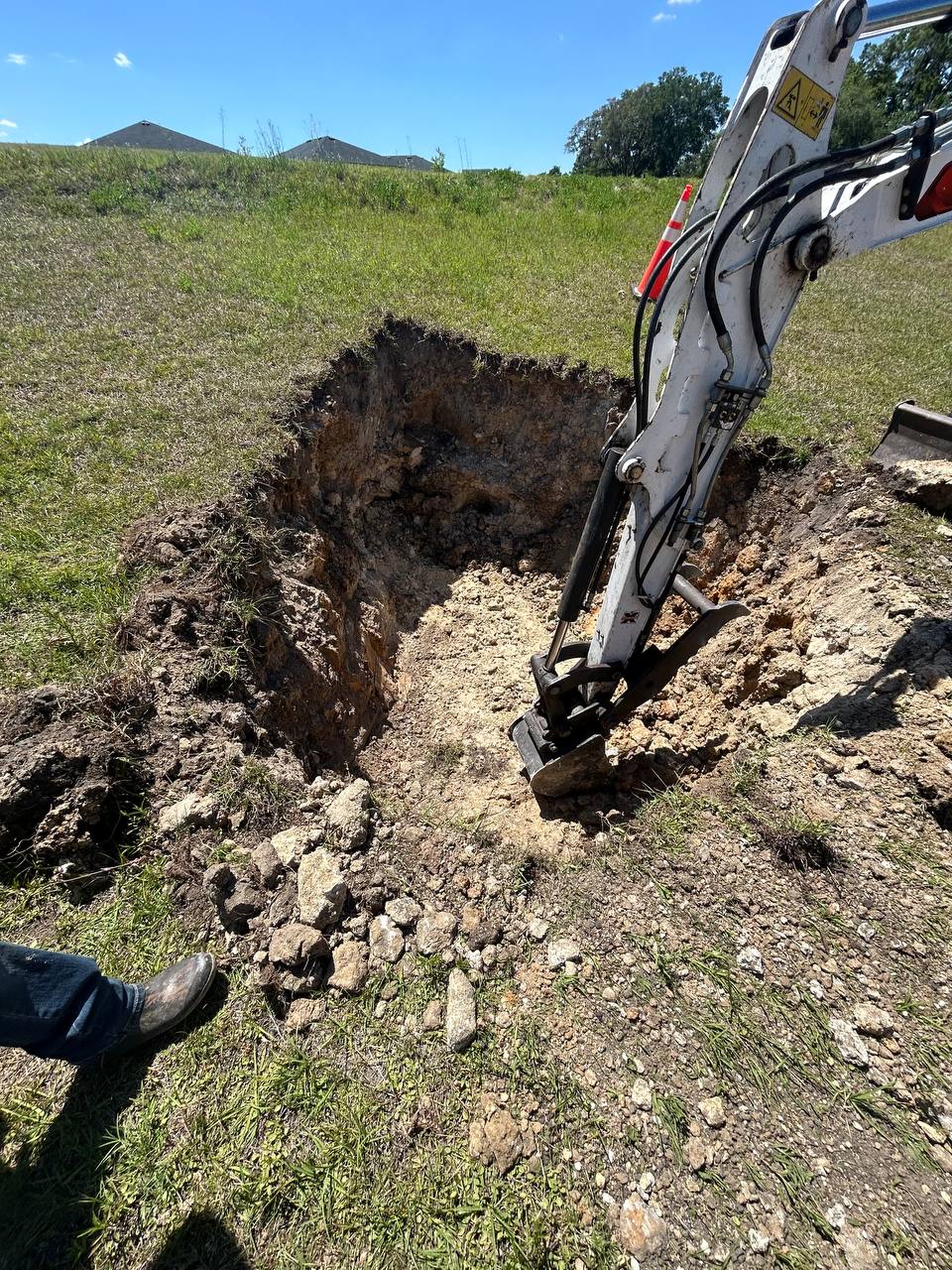
SPT · CPT · Rock Coring · Direct Push
SPT borings, CPT, rock coring & direct push drilling in Florida. Crews who know karst and shallow water tables. FDOT accredited. (352) 619-9292.
SPT · CPT · Rock Coring · Direct Push
Crews that know what Florida dirt is supposed to feel like — pinnacled limestone, lost circulation, organic muck at 32 feet — and what it means when something’s off. Modern automatic-hammer SPT rigs and an FDOT-accredited lab waiting for the samples.
Decades drilling Central Florida. When an auger feels different at 28 feet, when the rock surface is pinnacling, when circulation is about to drop into a void — our drillers notice. New crews don’t.
Modern automatic trip hammers deliver consistent energy. N-values you can trust for liquefaction analysis, bearing capacity, pile design — not the variable numbers a manual donut hammer gave you in 1985.
When SPT alone won’t tell the story — thin weak layers, sinkhole evals, deep rock — we add CPT for continuous profiles, rotary rock coring for RQD, and direct push for shallow environmental work.
Florida dirt won’t tell you what it is until you actually drill into it. You can look at the USGS map, the NRCS Web Soil Survey, the FEMA flood layer — you’ll get the general shape of the site. You won’t know what’s actually down there until somebody puts a hole in the ground and pulls samples out.
After enough borings across this state — Marion, Alachua, Hernando, Pasco, Citrus, all the way down the I-4 corridor — you learn that the difference between a sound foundation and a settlement problem six years later usually comes down to whether someone bothered to drill the extra ten feet. Or whether the driller noticed the auger felt different at 28 feet and stopped to figure out why instead of pushing through.
Florida Geotechnical Services drills SPT borings, advances cone penetration tests, cores limestone, and runs direct push from our Ocala base. Modern rigs, automatic trip hammers, and crews who have spent decades reading what the ground is trying to tell them. Samples come straight back to our FDOT- and CMEC-accredited lab — no shipping, no third party, no gap in the chain.
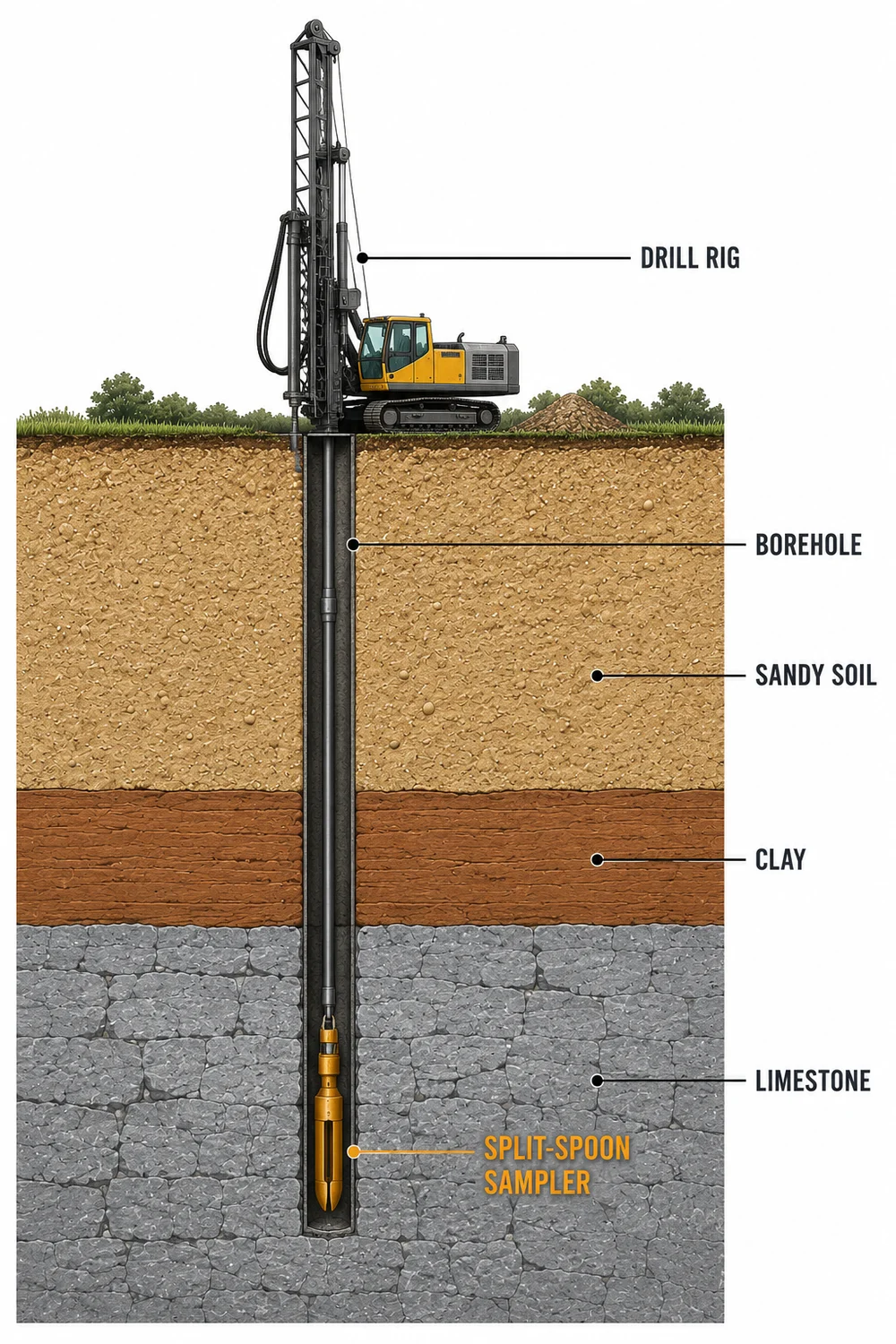
A site in Ocala that shows 20 feet of nice sandy soil with a clean SPT profile can have a zone of soft organic material at 35 feet that would never have been found without boring to depth. A site in Hernando County’s spring-fed sinkhole country can produce perfectly normal SPT results through the entire overburden, then drop to zero blows in what should be competent limestone — that’s a void, and the only way you find it is by drilling deep enough to hit it. A coastal site in Citrus County can have three feet of fill over eight feet of peat over a sand layer — a profile that looks nothing like what the Web Soil Survey predicted.
Experienced Florida drillers recognize these anomalies as they’re developing — not on the report three weeks later. They know when to advance beyond planned depth, when to switch from auger to rotary wash, when lost circulation means stop and document instead of push through. That situational awareness is the difference between a boring log that tells the full story and one that misses the critical detail. You can’t shortcut it. You can’t outsource it to whoever’s cheapest that week. It only comes from years of work in the same geology.
Different sites and different questions call for different methods. We use the one that actually answers the question — not just the one our equipment happens to be set up for.
The bread and butter. HSA holds the borehole open through Florida’s saturated sands without drilling fluid messing up your samples. Automatic trip hammer for consistent N-values. ASTM D1586. Most Central Florida residential and light commercial work runs on this.
When we need to go deep, transition through rock, or maintain stability in highly variable ground. Drilling fluid carries cuttings out, keeps the borehole intact, and reveals lost circulation as soon as it happens — your first clue that you’re over a void.
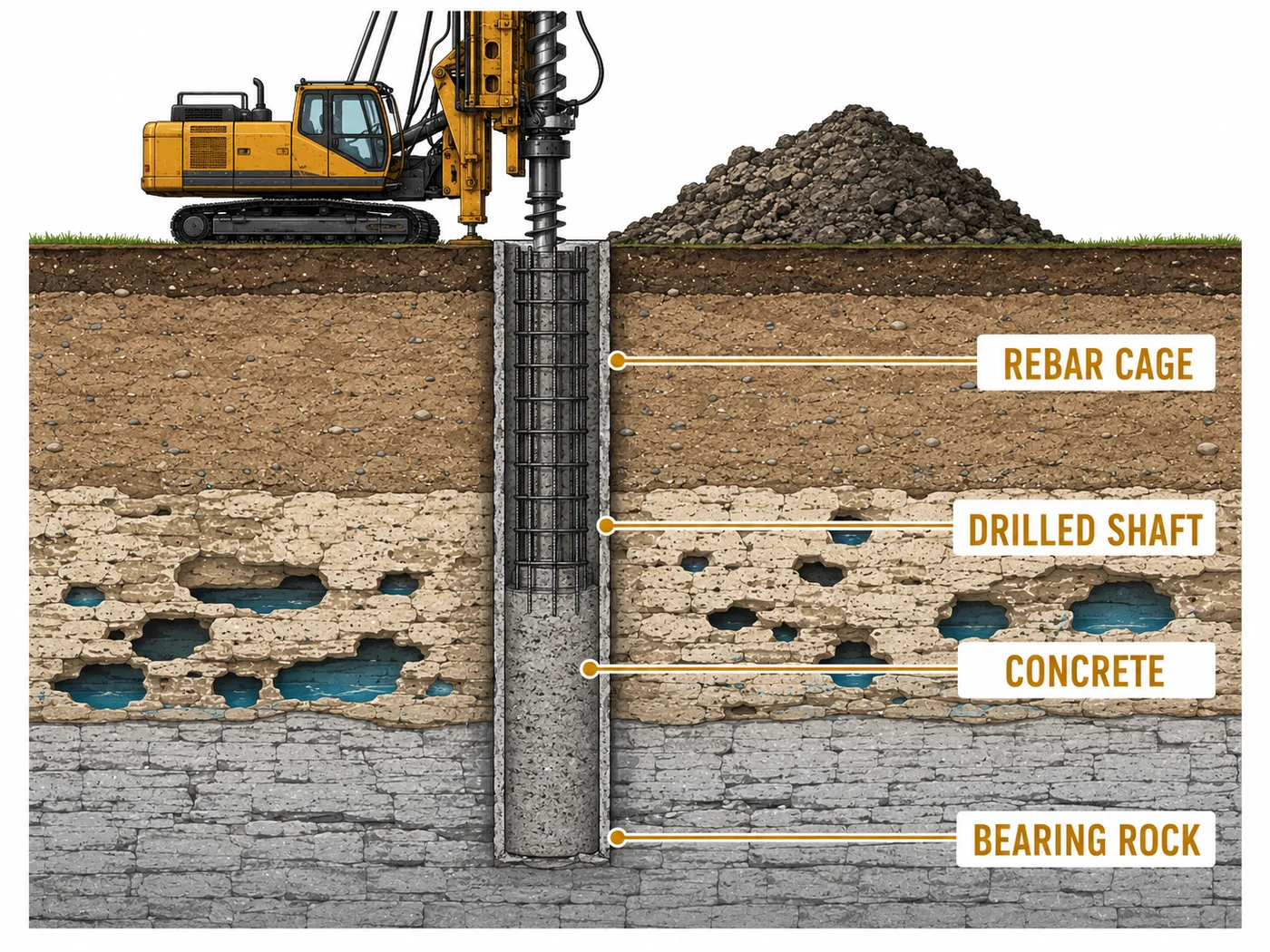
When the question is the limestone itself — bridge foundation, drilled shaft socket, sinkhole evaluation — we core. Diamond bits recover intact rock. RQD values quantify fracturing. Required on most FDOT projects involving rock. Used in sinkhole evals →
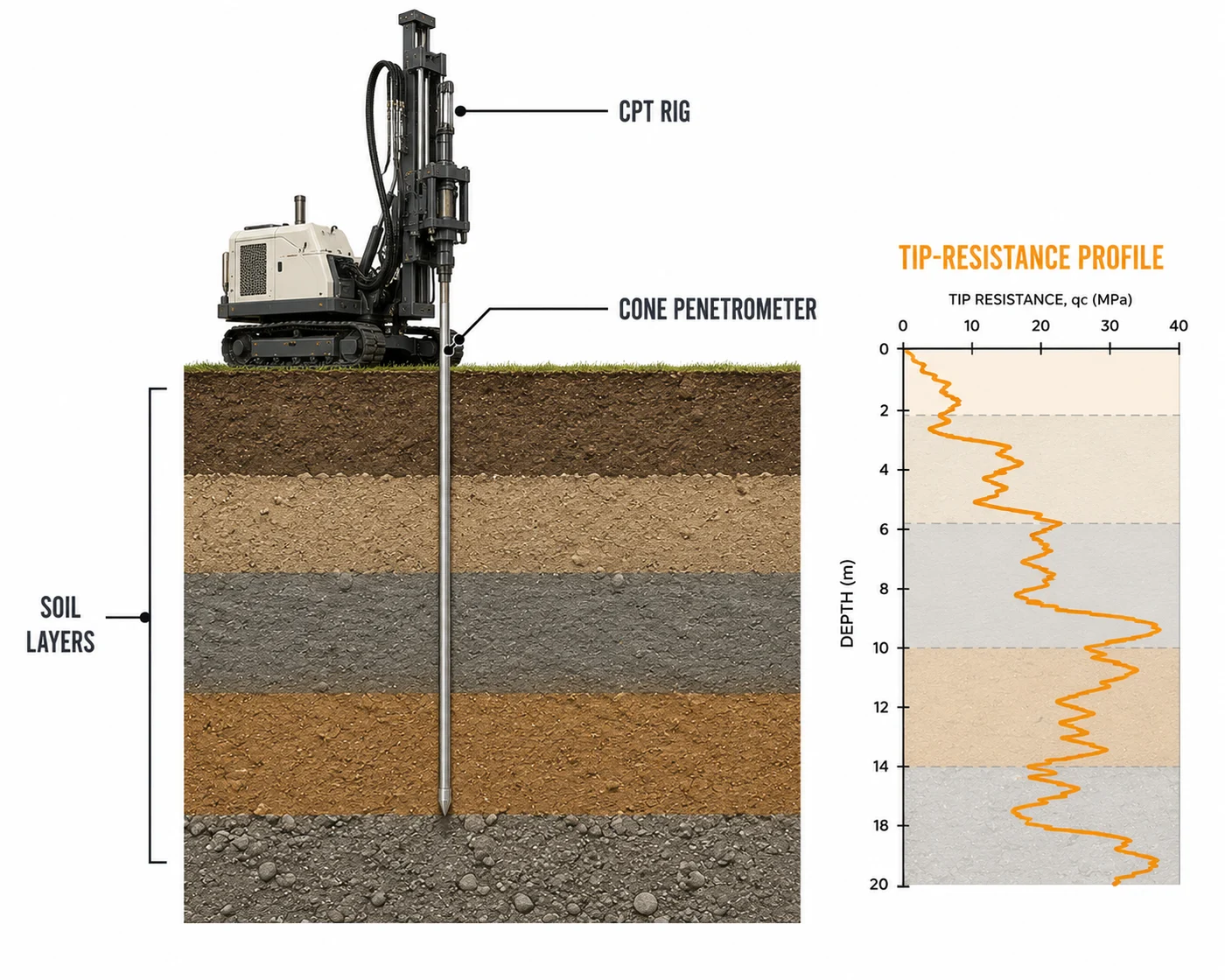
CPT gives you a continuous resistance profile — catches the 6-inch weak layer SPT would miss. Direct push is fast and minimally invasive for shallow environmental screening and preliminary site work. Both pair well with a few confirmation borings. When a project needs one, the other, or both is covered in our comparison of SPT borings vs. CPT for Florida projects.
Two of the most common questions we get. The honest answer is “it depends” — on structure loads, depth to competent bearing, the variability of the subsurface, and whether you’re chasing a hazard or just confirming the soil. ASTM D420 and the FDOT Soils and Foundations Handbook give the formal guidance. Typical practice in Florida looks like this:
20–30 ft, 2–4 borings
30–50 ft, one boring per major structural element plus perimeter
50–100+ ft, depths driven by foundation type
60–80 ft, or 10 ft into competent limestone, whichever governs
well into rock, per the FDOT Soils Handbook for the specific structure type
If you tell us the structure and the site, we’ll tell you what we’d recommend and why. We’ve gotten that conversation right enough times that we don’t feel the need to oversell — but we also don’t underspec a job to win a price comparison. Underspecced borings cost everybody more in the long run.
Most of peninsular Florida is wet from the first foot of overburden during the rainy season. That changes how you have to drill. Hollow-stem auger maintains the borehole. Water or mud fills the borehole in saturated cohesionless sands so soil doesn’t pipe into the sampler. A driller who’s used to dry climates will be surprised by this; ours aren’t.
In parts of the state, pressure in the Floridan Aquifer pushes water in the borehole above the static water table. Artesian conditions complicate sampling and need to be managed — not ignored. Sample integrity matters; if pore pressure is forcing soil into your spoon, your data is wrong before it ever leaves the field.
The Ocala Limestone surface in Central Florida isn’t a flat plane. It’s an irregular, dissolution-modified topography — pinnacles and depressions separated by a few feet. A boring that hits rock at 15 feet may be twenty horizontal feet from one that doesn’t see rock until 40. If the boring log just says “refusal at 15 feet” and the foundation engineer designs to that, the next boring location could collapse the assumption. Good drillers recognize pinnacled topography and flag it.
When the drill bit enters a significant void in the limestone, the drilling fluid disappears into the formation. That’s lost circulation, and it’s not a problem to be drilled through — it’s a flag. A void in the rock under a planned foundation needs to be identified, not ignored. We document and report it on the spot, because the next decision (drill deeper, switch methods, recommend an additional boring) belongs to the engineer, not the field crew.
Highly compressible organic layers — peat, muck, organic clay — appear at all depths in Florida coastal lowlands, river floodplains, and former wetlands. SPT N-values of zero. Sometimes the spoon won’t even hold the sample. These zones are critical to identify and characterize, and they require careful sampling — undisturbed tube samples for consolidation testing, where the sample is everything.
The value of a boring isn’t just in the drilling — it’s in what happens to the samples afterward. We label, seal, and transport every sample under chain-of-custody from the rig back to our Ocala lab. Undisturbed tube samples for consolidation and triaxial testing get handled with extra care to preserve structure, moisture content, and stress state. Because the lab is ours, there’s no shipping gap and no third-party hands. The sample you watched come out of the spoon is the sample that gets tested. See our Soil Testing & Laboratory Services for the full lab menu and turnaround.
We run track-mounted and rubber-tired rigs — track for soft ground and wetland margins, rubber-tired for paved surfaces and improved sites. Tight-access work, narrow lots, drilling through interior floors via doorway access — we have smaller equipment that fits. Mobilization to most Central Florida sites runs one to two business days. Sunshine 811 utility clearance happens before the rig leaves the yard, every time.
FAQ
Honest answer: it depends on the structure and what's under the site. Typical residential in Central Florida with shallow spread footings: 20–30 ft. Multi-story commercial with piles: 60–100+ ft. Sinkhole investigations: at least 10 ft into competent limestone, which sometimes means 60–80 ft of total depth. FDOT bridge foundations follow the FDOT Soils Handbook for the specific structure type. If we know the structure and site, we'll tell you what we'd recommend and why.
Depends on site size, structure configuration, and how variable we expect the subsurface to be. ASTM D420 and the FDOT Soils and Foundations Handbook give the formal guidance. For a residential lot, 2–4 borings usually suffice. For a commercial site, one boring per major structural element plus perimeter is a common starting point. For sinkhole investigations, we place borings to follow up GPR anomalies plus a systematic grid across the affected area. Underspeccing the boring count to save a few thousand dollars usually costs more than it saves.
Three to four weeks from end of fieldwork is typical — field drilling, lab testing of recovered samples, and engineering analysis. Drilling itself for a residential or small commercial site is usually one day. Expedited delivery is available when the schedule demands it. Call (352) 619-9292 to talk through your timing.
Yes — every time, before the rig leaves the yard. We contact Sunshine 811 prior to all drilling activities, review the site visually for surface indicators of underground utilities, and maintain minimum separation distances from marked utilities. Sunshine 811 clearance doesn't catch private utilities, so if you have as-built drawings or utility maps, send them over before mobilization.
Usually. Smaller track-mounted rigs handle limited overhead clearance, narrow corridors, and soft or unimproved ground. For real outliers — interior building investigations, drilling through floors, or very narrow utility corridors — we can talk through phased access or modified equipment. Send us a photo of the site and we'll tell you what's feasible.
Get started
Tell us about your project and we'll get right back to you. Industry-leading turnaround on stamped reports, fieldwork, and lab results.
Prefer to talk? (352) 619-9292
Thanks — we've got it and we'll be in touch within one business day.
Need it now? Call (352) 619-9292.
Statewide service area
FGS delivers geotechnical drilling across Central and North Florida from our Ocala lab. Explore the service in the communities we cover most: